
The modern Western performance horses were honed with work in mind—speed, stamina and the grit needed to hold it all together. The horses that laid the foundation for today’s performance athlete.
They say the entire town of McKinney, Texas, shut down for the match race.
It was 1854, and word had spread for months that Steel Dust—rumored to be one of the fastest horses on any Texas track—had finally met his match. The challenger was Monmouth, a Kentucky sprinter who was undefeated on tracks back East. Owned by a local McKinney man, Monmouth was heavily favored by the hometown crowd.
When he arrived, Steel Dust’s languid disposition did nothing to improve his odds. According to witnesses, the stocky bay stallion appeared half asleep. Confident in their choice, Monmouth’s backers wagered heavily—cash, saddles, livestock, even the clothes they were wearing.
That stocky, sleepy horse handily beat his adversary, and even today, Monmouth is best remembered as the horse that lost.
The race didn’t just cement Steel Dust’s celebrity; it branded his name onto the blueprint of a horse uniquely defined by the needs of a growing nation—a horse that would become America’s own.
Long before registries or associations for them existed, horses like Steel Dust were being bred, traded and proven—shaped and reshaped by the evolving demands of American needs, values and pastimes. Scrappy sprinters were just the beginning. Ranch work, cattle handling and, eventually, organized competition would each leave their mark, layering new traits onto the foundation those early horses established. Today’s performance horses can trace their evolution through those shifting demands and the notable forebears who rose to meet them. The following horses—by no means an exhaustive list—were highly influential in developing the specialized qualities and characteristics that define the modern performance athlete.
Needs of the New World
American colonists imported a penchant for fast horses and a culture that prized horse racing. But life in the New World quickly reshaped both the sport and the horse itself.
Thoroughbred racing suited English aristocrats and colonial gentry, but agrarian life in the colonies demanded utility. The same horses that raced on weekends were expected to work during the week. This dual need began shaping a horse that was not only fast, but durable. Imported English stallions were bred on hardier local mares to produce compact, muscular animals capable of both speed and labor.
This cross perfectly suited the informal match races that became a popular colonial pastime. Known as “path” or “street” races, they were typically quarter-mile sprints between two horses, often born from wagers or disputes among local gentlemen. Run on village roads, open paths or in front of taverns, these informal races rewarded quick acceleration and raw speed. From these contests, the names “Celebrated American Quarter Running Horse” and, later, “Quarter Horse,” would eventually emerge, named for the distance.
From type to bloodline
As emigrants moved west, they carried the sport with them. By the 1790s, quarter-mile tracks appeared in pre-statehood Kentucky. It was here that Steel Dust was born in 1843. Brought to Texas as a yearling, he built a reputation as a near-unbeatable sprinter. After his legendary win against Monmouth, his fame grew, and so did demand for his offspring.
Steel Dust stamped his foals with a distinct “bulldog” look that became a genetic cornerstone of what would eventually become the Quarter Horse. They were compact, short-coupled, heavy-muscled horses with strong jaws and small ears. They were explosively fast over short distances, but their value extended beyond the track. As ranching expanded across the West, these horses proved equally adept at cattle work. Cowboys sought them out, and the term “Steeldust” became shorthand for a good using horse.
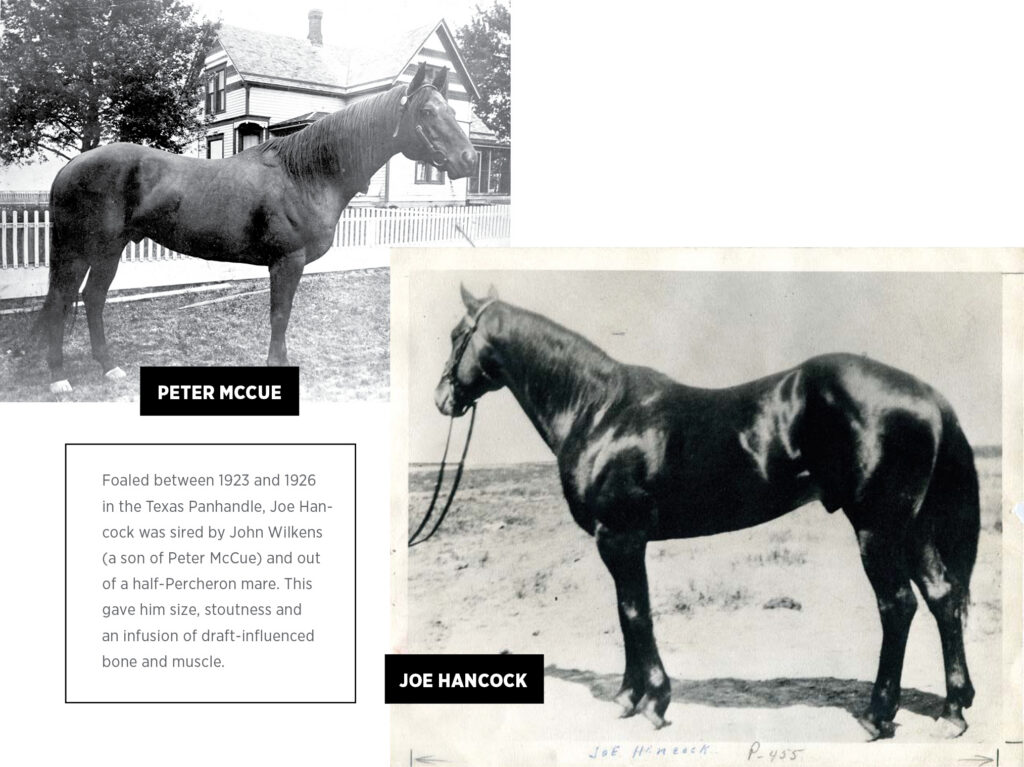
Steel Dust set the template, but it would take the next generation of sires to make that type consistent. Foaled in 1895 in Illinois, Peter McCue carried Steel Dust blood through his dam line and proved himself on the track before becoming one of the most influential sires of the early 20th century. Coke Roberds, one of his later owners, declared, “Peter McCue was unquestionably the greatest sprinter and sire of short horses that ever lived,” while horseman Milo Burlingame called him “the greatest ‘short-horse’ in the history of the world, and also the finest breeder.”
The stallion reliably stamped his offspring with the same speed, substance and athleticism that had made Steel Dust famous, helping transform a desired type into a repeatable one.
Built by the West
Following the Civil War, Texas was rich with feral cattle and eastern states were hungry for beef. This ushered in the era of the cattle drive and the rise of the great ranches of Texas. The demands placed on horses changed again. Speed still mattered, but it had to be paired with stamina and cow sense. Horses were expected to cover hard miles, read a cow and hold up through long days in tough country.
Few places shaped that evolution more intentionally than the King Ranch and its cornerstone stallion, Old Sorrel. Standing at 14.3 hands with exceptional balance, conformation and a calm temperament, Old Sorrel proved himself an outstanding working cow horse under saddle, as noted by King Ranch president Robert J. Kleberg Jr.: “[The stallion] was the best cow horse I ever rode.” When he was first bred to a band of carefully selected mares, the results were strikingly uniform—early proof of his ability to consistently pass along his traits. Just as important was his own versatility. As longtime King Ranch veterinarian J.K. Northway recalled, he could be worked all morning and raced in the afternoon—a horse that could rope, cut and handle any job on the ranch. Through controlled linebreeding, Old Sorrel’s influence spread across ranching, cutting, reining and racing, and today, his blood runs through nearly every Quarter Horse produced on the King Ranch.
If Old Sorrel represented the ultimate expression of a practical, all-day ranch horse, then Joe Hancock contributed grit, bone and raw power. Foaled between 1923 and 1926 in the Texas Panhandle, Joe Hancock was sired by John Wilkens (a son of Peter McCue) and out of a half-Percheron mare. This gave him size, stoutness and an infusion of draft-influenced bone and muscle.
His progeny were prized for toughness, soundness, cow sense and withstanding hard daily use. Hancock-bred horses earned a reputation as “cowboy’s horses”—big, strong and durable, often with a bit more grit that made them excel in high-stress working environments. His line added the raw power and bone that many performance horses still draw upon.
Together, horses like Old Sorrel and Joe Hancock helped define the ranch horse, laying the groundwork for the performance horses that would follow.
On the books
With the founding of the American Quarter Horse Association on March 15, 1940, the Quarter Horse was no longer just a regional type—it was a recognized breed. As demand grew for horses that could perform consistently across ranches and arenas, the need to define the Quarter Horse became just as important as developing it.
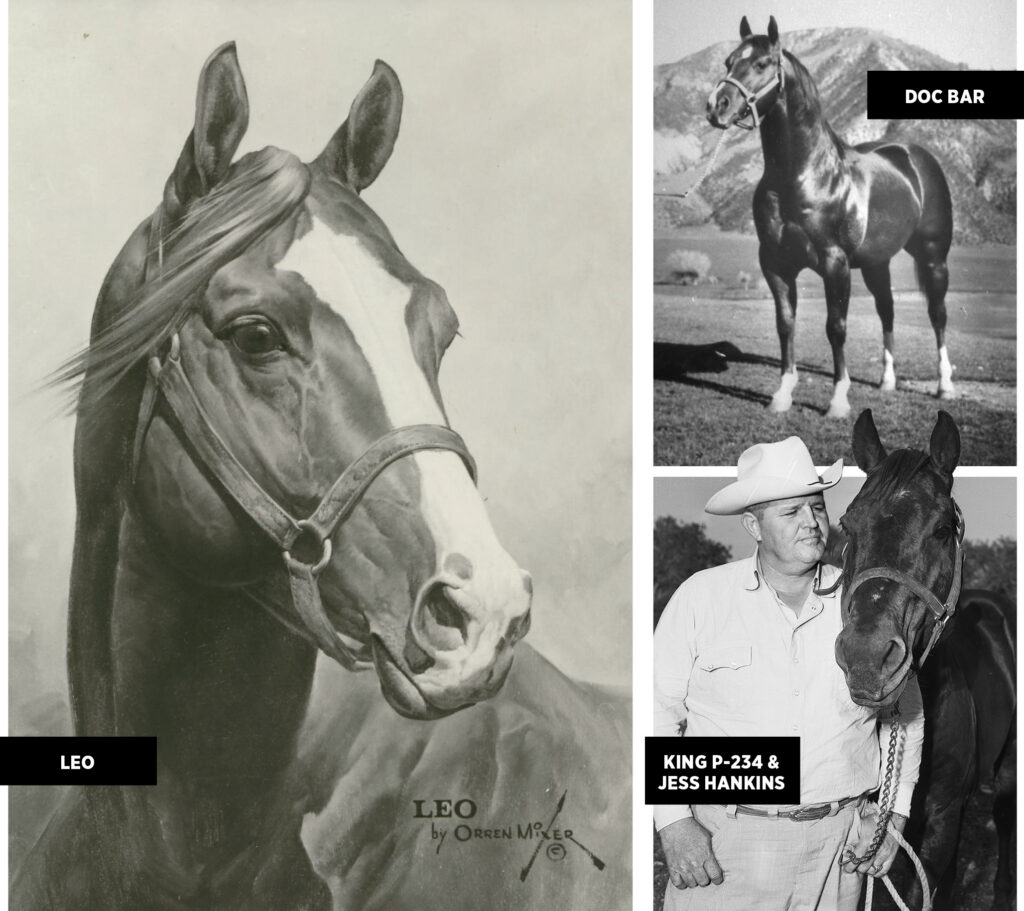
Foaled in 1932 on a ranch near Laredo, Texas, King P-234 stands as one of the most dominant and widespread influences in AQHA history. He sired more than 600 registered offspring, including 20 AQHA Champions, and his ability to pass along his traits helped solidify the kind of horse breeders were trying to define.
King embodied the classic early Quarter Horse ideal: heavily muscled, quick, with strong cow sense and ranch-working ability. As a cornerstone sire in the foundational era, King provided the genetic volume that spread these qualities widely, appearing in countless pedigrees of performance horses.
If King established a foundation, Leo expanded it. Foaled in 1940, Leo was a AAA racehorse and an elite sire who combined speed with superior conformation, quiet disposition, and strong cow sense. He produced numerous Register of Merit, Superior and Champion performers in halter, cutting, reining and other events. Leo’s get were known for trainability, athletic burst, soundness and mental willingness—making them ideal for the emerging show and performance scene.
Both horses reinforced the Quarter Horse as a versatile athlete and scaled the breed for modern performance, as demand shifted from all-purpose ranch horses to more specialized competitors. King acted as the broad distributor—his blood flooded the early registry and set the standard for what a performance Quarter Horse should look and act like. Leo served as a potent upgrader, refining that foundation into more polished, competitive horses. Together, they helped transition the Quarter Horse from a ranch- and race-type into a purpose-bred Western performance athlete.
An important outcross
Foaled in 1940, Three Bars was the single most impactful Thoroughbred sire on the Quarter Horse breed. As racing and performance demands placed greater emphasis on speed and athleticism, breeders turned to outcrosses like Three Bars to elevate those traits without sacrificing the cow sense and practicality already established in foundation lines.
Three Bars’ impact was immediate and far-reaching. He sired 20 AQHA champions and hundreds of race earners, and his offspring excelled not only on the track but across disciplines. More importantly, his blood carried forward through generations, most notably through his grandson Doc Bar, whose influence would help define the modern cutting horse.
The cow horse becomes an athlete
By the mid-20th century, postwar prosperity expanded leisure time and mechanization reduced the need for horses in daily ranch work. The country shifted from work to recreation, and the horse followed.
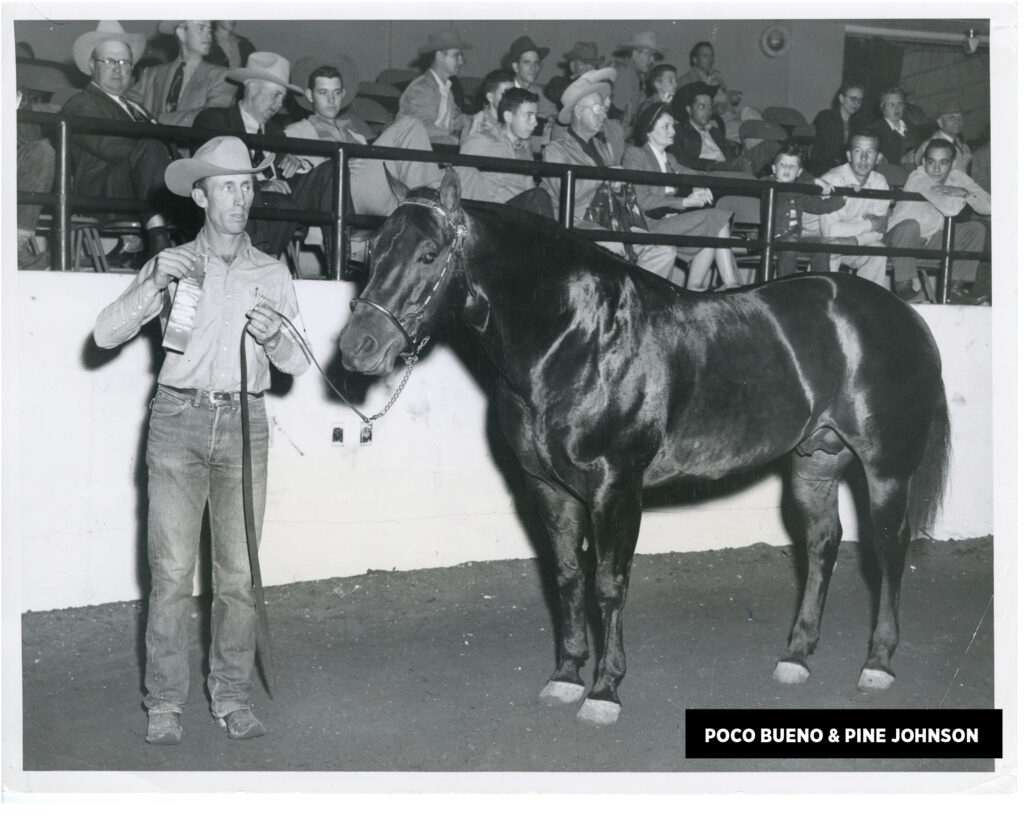
Foaled in 1944, Poco Bueno carried forward the legacy of King P-234 but elevated it in a way few horses had before. Purchased by the Waggoner Ranch as a yearling, the plain brown colt developed into a cutting horse of remarkable ability under trainer Pine Johnson. Smooth, quick and powerful, Poco Bueno redefined what riders expected from a cow horse.
“I’ve never ridden a horse like him,” Johnson recalled. “He seemed to take off [of] the ground and just freeze to stop.” His athleticism was so intense that Johnson famously had to hold onto the saddle horn to keep up with him, a style that eventually became standard for high-level cutting. Poco Bueno sired more than 400 foals, including multiple champions and Hall of Fame cutting horses, and his influence helped establish cutting as a discipline built around finesse and feel.
If Poco Bueno proved what a great cow horse could do, Doc Bar refined how they were bred. Foaled in 1956 and originally intended for the racetrack, the sorrel stallion failed as a runner but found his calling in the performance arena. Smaller and less conventionally built than his contemporaries, Doc Bar challenged prevailing ideas about what a Quarter Horse should look like. His offspring were known for a unique, consistent phenotype: low-set, muscular and catty, setting new conformation standards for cutting and working cow horses.
At the same time, large ranch programs continued to refine Quarter Horse bloodlines. At the 6666 Ranch, Hollywood Gold emerged as one of the most influential foundation sires of his era, bridging the gap between the rugged utility of the early ranch horse and the specialized athlete that would follow. A natural cow horse, he sired more than 260 registered foals, including numerous Superior cutting horses, and became known for passing along an instinctive ability to read and outthink cattle. Often crossed on Joe Hancock-bred mares, his offspring were prized for their durability, bone and stamina, as well as their intelligence and trainability—hallmarks of the old Steel Dust type. Perhaps Hollywood Gold’s most visible impact today is through the Hollywood line in reining. Although he was a cutting sire, his genetics paved the way for the greatest reining stallion of all time: Hollywood Dun It.
America’s horse
From the dusty match races of the colonies to the vast ranches of the West and, eventually, the bright lights of the arena, each era shaped today’s equine athletes. What began as a compact sprinter became a dependable ranch horse and, from there, a refined and specialized athlete. Horses like Steel Dust proved what was possible. Peter McCue made it repeatable. King and Leo helped define it. Three Bars refined it. And Poco Bueno, Doc Bar and Hollywood Gold carried it into the modern era.
—H&R—