



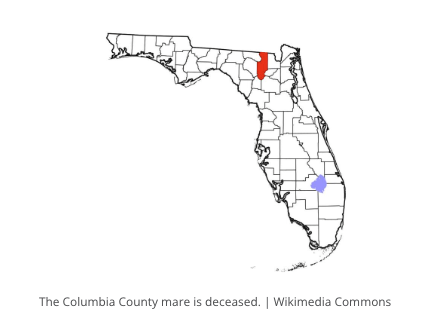
On May 18 the Florida Department of Agriculture and Consumer Services confirmed a horse in Columbia County has tested positive for Eastern equine encephalitis (EEE). The 4-year-old unvaccinated pony mare began showing clinical signs of apprehension, depression, fever, muscle twitching, incoordination, an inability to stand, head-pressing, and listlessness on May 9. Test results confirmed the cause as EEE on May 17. The mare is deceased.
The Equine Disease Communication Center released this information on May 18, 2022.
EEE 101
Eastern equine encephalomyelitis is caused by the Eastern equine encephalitis virus, for which wild birds are a natural reservoir. Mosquitoes that feed on EEE-infected birds can transmit the virus to humans, horses, and other birds. Horses do not develop high enough levels of these viruses in their blood to be contagious to other animals or humans. Because of the high mortality rate in horses and humans, EEE is regarded as one of the most serious mosquito-borne diseases in the United States.
[More on mosquito-borne diseases: What’s the Buzz?]
Tips for preventing mosquito-borne diseases include:
- Avoid mosquito bites: Use insect repellent when outdoors, especially from dusk to dawn.
- Look for EPA-labeled products containing active ingredients such as DEET, picaridin (KBR3023), or oil of lemon eucalyptus (p-menthane 3,8-diol).
- Apply more repellent, according to label instructions, if mosquitoes start to bite.
- Mosquito-proof homes: Fix or install window and door screens, and cover or eliminate empty containers with standing water where mosquitoes can lay eggs.
- Protect your horses: Veterinarians recommend commercially available licensed vaccines against EEE for all horses in the U.S. Horses should be vaccinated at least annually (recommendations vary in high-risk areas). It’s not too late this year to vaccinate your horses.
- Use approved insect repellents to protect horses.
- If possible, put horses in stables, stalls, or barns during the prime mosquito exposure hours of dusk and dawn.
- Eliminate standing water, drain water troughs, and empty buckets at least weekly.
- Stock water tanks with fish that consume mosquito larvae (contact your local mosquito control for assistance), or use mosquito “dunks” (solid “donuts” of Bacillus thuringiensis israelensis[BTi], which are nontoxic to horses) available at hardware stores.