



Do you know how to give your horse a double-whammy reward? Both positive and negative reinforcement at the same time?
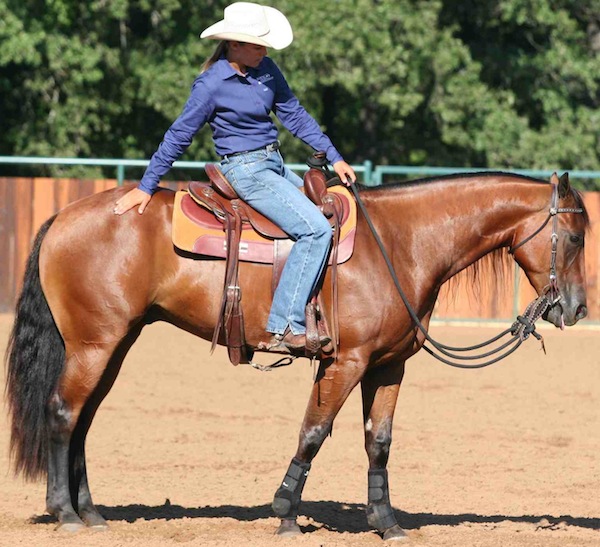
It’s easy—do as the trainer in the photo is doing. After your horse has responded well to what you’ve asked of him, give him a nice rub–that’s the positive reinforcement…offering him something he enjoy.
At the same time, allow him to stand and relax for a moment; that gives him more positive reinforcement (the relaxing) plus adds negative reinforcement (you’ve taken away something he doesn’t want, by ceasing all cueing).
This makes it perfectly clear to your horse that you’re pleased with him. It also gives him a moment to process the learning. In other words, he’s thinking, So THAT’s what she wanted, and this is what happens when I do it. Nice!
This mulling-over is why horses often lick and chew during this interval of rest…those are indications of thinking.
You can take this kind of double-whammy reward even further, too.
“If [your horse] has done particularly well,” writes world champion trainer Al Dunning in Ultimate Level of Horsemanship: Training Through Inspiration, “the reward may be that you get off, uncinch the saddle, and lead him back to the barn—right from that spot where he did so well. This may reap better results than following through with a prearranged plan.”
So, what’s the opposite of a great reward? Asking your horse to repeat the good thing he did over and over. Ten lope departs in a row. Seven slide stops. Six sidepasses–whatever.
If you do that, you muddle the issue.
“It can confuse a horse when he does something right, yet you make him keep doing it repeatedly,” writes Dunning. “He’s not being rewarded for good behavior.”
And, in a way, he’s being inadvertently punished for it.
So–know when to take a break, and when to call it quits. Your horse will thank you for it, plus learn faster and better.
Read more about how and why rewards work; the importance of timing in giving rewards; the pros and cons of feeding treats; plus other examples of letting learning sink in.