


For NRCHA professional Chris Dawson, finding the right horse has always been about more than talent or a show record. It’s about finding the right fit between horse and rider. Through his involvement with Charlie Five, that philosophy has taken on a new meaning.
Dawson first connected with Charlie Five founder Jeremy Svejcar through War Horses for Veterans, a Kansas-based nonprofit that provides equine experiences for military veterans and first responders. Since then, he’s helped pair veterans with horses of their own, coached participants preparing for the War Horse Challenge and developed relationships that extend well beyond the show pen.
Along the way, Dawson has discovered that working with veterans hasn’t just given him an opportunity to share his knowledge. It’s changed the way he approaches training horses and coaching riders. This is the third installment in our series; read Part 1 with Charlie Five founder Jeremy Svejcar and Part 2 with Bill Norman.
Horse&Rider: How did you first get involved with Charlie Five and its founder, Jeremy Svejcar?
Chris Dawson: I got to know Jeremy through War Horses for Veterans. He helped get Jacob Greenlief connected with War Horses, and my first interactions with Jeremy were through some of those guys who would stay at his house on their way out to Las Vegas. Jeremy would come along with them, and that’s how we met.
Since then, he’s been out to my place a little bit, and we’ve helped place a few horses. It’s been pretty cool to see some of the relationships we’ve been able to help develop.
H&R: You’ve helped Charlie Five find horses for veterans and first responders. What goes into finding the right horse for each person?
CD: I’m around a lot of horses in a lot of different situations, and finding the ones that will fit each person is so individual and unique. I wish there was a cookie-cutter plan for finding one, but there really isn’t.
A lot of times, Jeremy will have three or four guys on the docket. He’ll call and tell me what we’re looking for, and I usually know most of those guys. As horses become available, sometimes unique situations arise where owners are able to get creative, and we can capitalize on those opportunities.
It’s really just such an individual situation. It’s horse by horse and guy by guy.
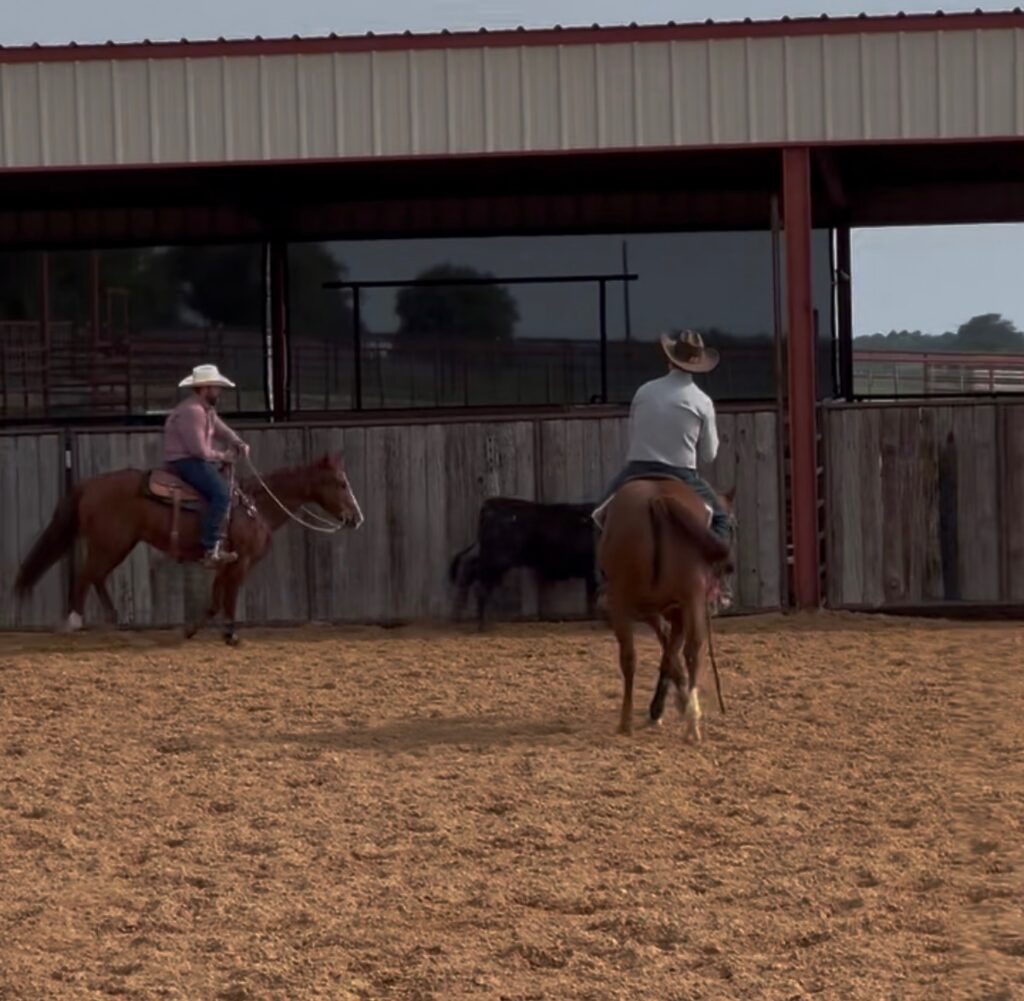
Photo: Chris Dawson credits the clinics as the reason why he’s able to get to better know the veterans and first responders who are looking for new horses. | Courtesy Charlie Five
H&R: Are there any horse-and-rider pairings you’ve helped facilitate that stand out to you?
CD: I’ve been really instrumental in two that came off my place.
One was a 3-year-old that had a little bit of a tendon injury. It was nothing major, but it was enough to keep him from being on track for the snaffle bit. The guy who needed him was a pretty proficient rider, and he wasn’t really interested in showing at the time.
He was confident as a rider, which was what that horse needed. He also needed a companion and something he could ride and develop a relationship with. That worked out really well.
I think he’s going to start showing that horse next year. He’s been hauling him around to some lessons, and I believe he’s planning to show more heavily next year.
I had another horse that was a finished show horse. I’d probably won $70,000 on him, but he had some questionable X-rays. I didn’t think he was necessarily going to fit into a traditional training program.
He’d done both cow horse and cutting, and we had a guy up in the Northwest who wanted to compete in both events and had the resources to do it. We got them paired up, and he won two buckles on that horse this year.
That was a really good pairing, and it was great to see them have some success together.
H&R: It sounds like matching personalities is just as important as finding a horse with the right experience.
CD: One of our other guys found a horse at another trainer’s place up in Colorado. He’s kind of a high-strung little fella who likes to ride a lot, and he found a high-strung little mare that needed to be ridden a lot.
Jeremy helped get the price down to where everybody could nod their head yes, and man, that little duo is doing really well. Their personalities just matched up.
That’s such a big part of it, making sure those personalities are going to match. It’s not just, “Hey, OK, here’s a horse, and here’s a guy.” There’s a fair bit that goes into making sure it’s going to be a successful partnership.
H&R: How do Charlie Five and War Horses for Veterans complement each other when it comes to helping these veterans?
CD: They’re definitely separate organizations, and I think Jeremy wants to make sure Charlie Five maintains its own identity. But it’s one of those deals where a rising tide raises all ships, and it takes all of them.
I think it would be really difficult if Jeremy were to just call me and say, “Hey, I’ve got this guy, and I need a horse.” It would be hard for me to find him one without knowing anything about him.
It’s really helpful when these guys have gone through other programs and built those relationships. Then, when Jeremy calls and says, “Hey, I need a horse for Bobby, or I need a horse for Rick, or I need a horse for Ryan,” I can say, “OK, roger that. Let me be on the lookout.”
Then I can call him back and say, “Hey, I’ve got one. He might fit this guy, but I think he’d really fit this other guy.”
H&R: You’ve also been involved with the War Horse Challenge, helping veterans prepare to compete in front of some of the biggest crowds in the cow horse industry. What’s that experience been like?
CD: I’m going to tell you what, it’s probably as nervous as I’ve ever been for showing.
That first one, we had no idea how it was going to go. I can promise you, I’ve never had butterflies like I did that first time in Las Vegas.
The guys we’ve gotten to work with have really become family, and that’s been the most special part of it.
When you can give those fellows the gift of applause from the crowd, that’s something special. You can’t just give that to somebody. They have to earn it. But to put somebody in a situation where they get to experience that is pretty incredible.
I tell them all the time, “Y’all have done way cooler stuff than what we’re going to do out here chasing some stupid cow around this arena. But you probably didn’t have a crowd of people on their feet cheering for you when you did it.”
To give those guys a little taste of that feeling is a pretty special gift.
H&R: Beyond the competition itself, what have those relationships meant to you?
CD: Those relationships have really been the special part of it.
I was with Mark the first time, and now I try to build my schedule around him. If Mark calls and wants to go do something, he’s almost turned into a father figure for me. It’s kind of like, “All right, roger that. We’ll meet you here and do this.”
He’s gotten me into jumping out of airplanes and doing all kinds of craziness.
I think Ryen is coming down next month to look at my place. He’s thinking about coming down and working for me next year, and we’re going to try to create a ranch manager position for him if we can figure out all the details.
Being able to link these families together, bring these guys back into a sense of community, and give them another team to be on is a pretty cool deal.
When you can give those riders the gift of applause from the crowd, that’s something special. You can’t just give that to somebody. They have to earn it.
— Chris Dawson
H&R: Many of the veterans you work with have very little competitive riding experience before getting involved. What’s it like coaching them?
CD: I’m going to tell you, the worst thing about this deal for the industry is that we’re putting these non-pros at a big disadvantage because we’re spoiling the horse trainers.
These guys show up and offer absolutely zero excuses. They’re so easy to coach, and it’s unbelievable.
I have non-pros who have been riding for years, and they’ll find excuses for why things went well, for crying out loud. I’m like, “Would you please stop that? Just yes or no, ‘I don’t understand,’ or ‘OK, roger that.’ That’s all I need to hear right now.”
Working with these soldiers has definitely shortened my patience for excuses, but it’s also changed how much responsibility I give my riders.
I think I have to give a little credit to the soldiers for helping restructure my teaching style and training program.
H&R: How has working with these veterans changed the way you approach coaching and horsemanship?
CD: It’s changed my teaching style because I’ve learned how to strip down the information, identify what really needs to get done right now, and then add more information slowly.
I think it’s helped my horse training and my coaching because you have to make things so black and white and simple.
Once they get that fundamental down, you can give them more information. But you’ve got to give it to them straight, with no frills and no extra words. Just, “This is what we have to do right here, right now.”
When you communicate that way, man, it’s unbelievable how quickly they pick it up.
These guys show up and offer absolutely zero excuses. They’re so easy to coach, and it’s unbelievable.
— Chris Dawson
H&R: Was there a particular moment during one of your clinics that changed the way you think about teaching?
CD: One moment that really stands out, where I figured something out about coaching and training, was when J.D. Struxness was helping us soldiers and horse trainers with steer wrestling.
It was a four-day deal. We’d work horses in the morning, and then he’d show up with the dummy. We started there, progressed to the horse dummy, and by day three, we were chute dogging live cattle.
What I realized was that some of these guys were way bigger and more fit than me, but they were coming at those cattle with a lot of rage and anxiety. That anxiety would turn into anger, frustration, and all these other things.
The guys who were able to process what was happening and stay calm got so much better, so much faster.
That was a realization for me that, in horse training and coaching, probably the primary job I have is managing anxiety.
If I can keep everybody in the right headspace, that’s probably more important than the things I’m actually teaching them.
If I can show them the way without causing so much mental stimulation, they pick it up. They can keep breathing, keep responding, and avoid getting into that fight-or-flight situation.
I feel like that’s really helped me with my horses, and it’s helped me with people as well.
Charlie Five
Charlie Five is a 501(c)(3) nonprofit founded and run by Jeremy Svejcar and his wife, Rose. It creates opportunities for qualified military veterans and first responders who need a horse to take them to the next level in the Western performance horse world. Since its founding in 2016, Charlie Five has filled a gap for men and women who find healing through horsemanship programs but graduate without a next step. Under its motto, “Earned. Not Given,” Charlie Five matches warriors with horsepower that can carry them into the industry’s most competitive arenas.
“We expect a lot from the veterans and first responders who want to become part of Charlie Five because the horse doesn’t get a choice in the matter. Our first responsibility is to the horse. When we place a horse with someone, that person assumes responsibility for another living animal. The participant has to be willing to learn, prepare, show up, ask for help, put in the work and provide the level of care that horse deserves. We can support them, mentor them and create opportunities, but we cannot do that work for them. That responsibility is part of the growth.”