



When you have a pattern that requires horses to perform physical maneuvers like sliding stops and multiple spins, it’s hard to believe that most non-pro riders find themselves in the penalty box over something as simple as large and small circles.
But the truth is, while circles look straightforward, there’s a lot of strategy involved with this maneuver.
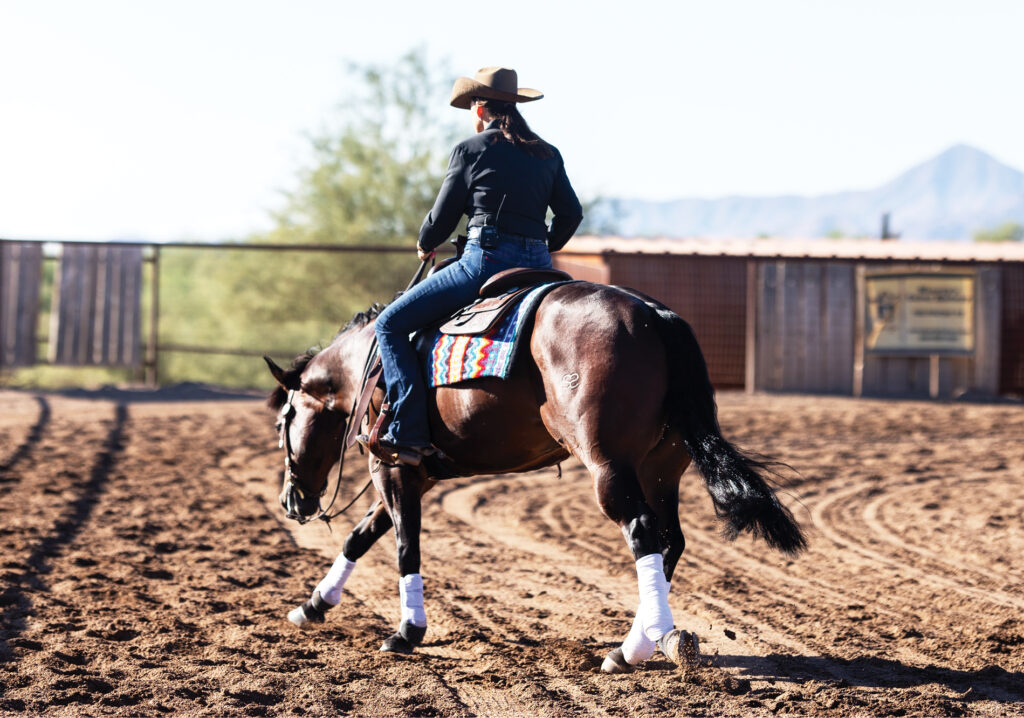
It Starts in the Center
Most of the time, you’ll find yourself starting your circle in the middle of the arena. Whether you’ve just completed a set of spins or you’re walking into the center of the pen to begin your pattern.
Before you even lope off, make sure your eyes are up and you know where you want your horse to go. If you’re looking down, you won’t know where your markers are and won’t be able to plan accordingly to ensure your circle is even on all sides of the arena.
When I cue for the lope, I take a couple of walk steps to check in with my horse and make sure he’s collected.
What you don’t want to do is go from a standstill and kick your horse into full speed. Remember, reining is all about finesse. Your pattern needs to be pleasant to watch and isn’t just about going as fast as you possibly can.
Pick Your Speed
Speed kills—especially if you don’t practice the speed you want to show beforehand.
Say you have a speed gauge that goes from zero to 10, with 10 being the fastest. If you practice at a four at home but try to reach a six or seven in the show pen, things will fall apart… fast. If you’re going faster than you’re used to, there’s a higher probability of your horse falling out of lead in the hind end or struggling to slow down for small circles.
Instead, practice a little faster than what you plan to show, so you know you have control every step.
You also need to be consistent. You should be at your max speed by the time you reach the first quarter of your circle and maintain that speed until it’s time to slow down or change leads and go the opposite direction.
Slow It Down
Some horses take a few strides to slow down before reaching the center of the arena, while others can transition from fast to slow in the blink of an eye. It’s important to know what your horse is capable of and show him accordingly. The same goes for you—do you need a few strides to prepare for the next maneuver, or can you go from fast to slow with ease?
Make sure that when you slow down, your horse stays cadenced, and you keep a steady rhythm in your seat
so he doesn’t break gait.
Check In
Don’t forget to check in with your horse before entering the show pen. Make sure that when you ask for more speed, your horse stays with you. You don’t want to be a backseat passenger in the show pen, and you definitely don’t want your horse going faster than what you ask him to.
Test your buttons in the warm-up pen. Does your horse slow down when you hum? What about when you take your leg away from his side? Do your voice, hand, and leg cues mean something to him, or is he distracted?
These are all things that will help keep you stay penalty-free in your circles when it comes time to show.
Crystal McNutt, trains reining horses and coaches amateur riders in Scottsdale, Arizona. She’s had especially notable success showing Arabians and Half-Arabians in NRHA and Arabian Horse Association events, but she also shows stock breeds. In 2011, she was inducted into the Arabian Professional and Amateur Horseman’s Association Working Western Trainer Hall of Fame and named the Horsewoman of the Year for that group.