



This is a class of yearling performance fillies, so I judge them for how they fit the needs of their
prospective careers. Over the years, I have seen several horses overcome conformation flaws to perform well, but even though flawed conformation may be overcome from time to time, that horse will have to work much harder to be successful than will a horse with better balance and structure.
A horse that is high in the hocks as a yearling will remain high in the hocks for life. Horses with hocks that
sit higher than their knees will struggle to be able to lift their front ends up and reach underneath themselves with their hind legs. They may be able to do it but will work much harder than a horse that’s level from knees to hocks. That high-hocked conformation may also predispose them to lameness down
the road.
A yearling with the best overall balance and structural correctness makes the best prospective performance horse. High hocks factor into this class of fillies, as I assess them as future athletes.
How to Take a Good Conformation Clinic Photo
The Placings
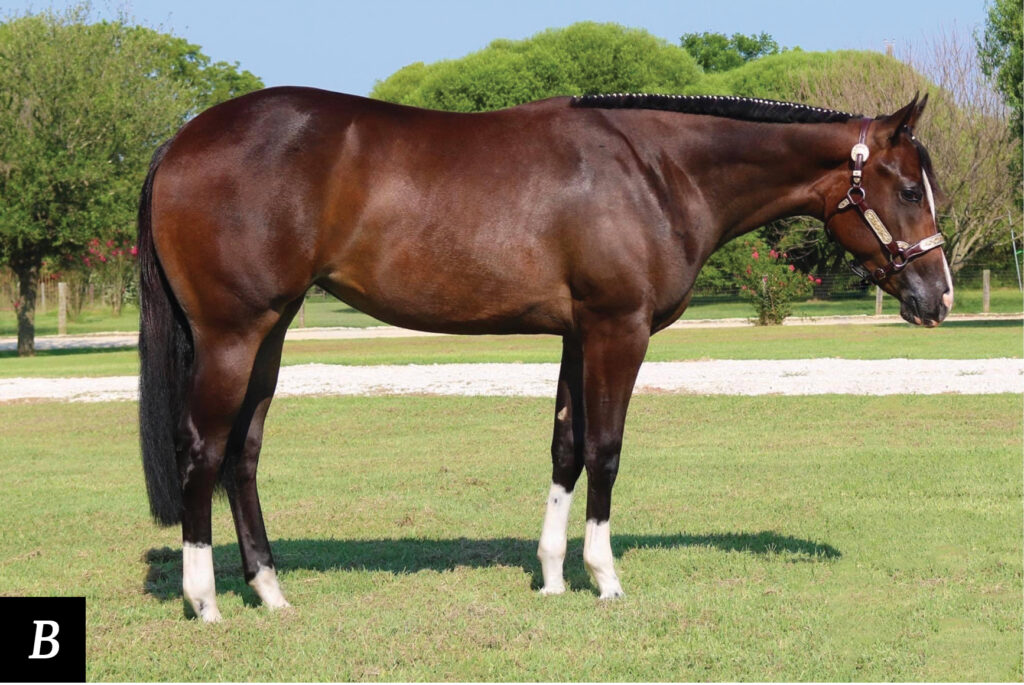
🥇 Filly B
Pretty to look at, this filly is built very correctly and is nicely balanced from front to back and top to bottom. Her strong, level topline is one of her best attributes, and relates to her knees and hocks being level with each other. She’s built to be able to do her job.
Her attractive head with large, soft eyes and small ears joins her neck through a shapely throatlatch. Her neck is long enough but could tie into her chest a touch higher. Her shoulder is slightly steeper than ideal, but her front pasterns match her shoulder angle, which will help give her a smooth stride. She shows adequate depth of heartgirth and overall muscling.
Her front legs are flat through the knees with pasterns of good length and slope that matches her shoulder angle. She has a strong hip, and her hocks are positioned under her well for the ability to drive off her hind end. Her hocks have the right amount of angulation, and as mentioned before, sit low to the ground, level with her knees.
Put your Conformation Clinic skills to the test!
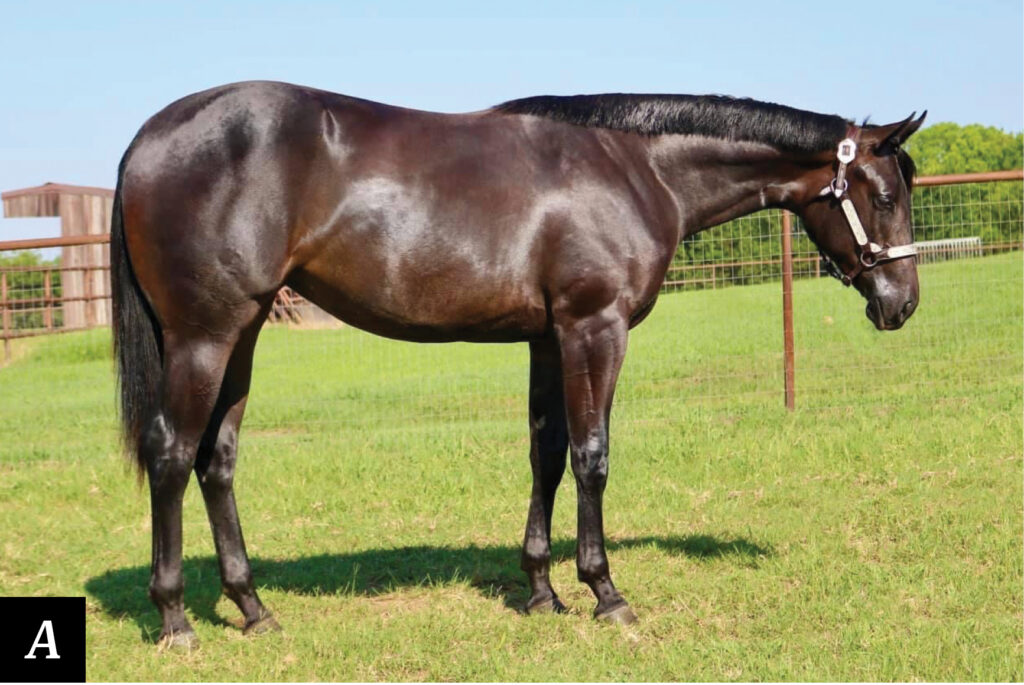
🥈 Filly A
This filly isn’t as well balanced from front to hind end as Filly B, and doesn’t have the level topline. She has some attractive individual components but doesn’t put them together as well as the first-place filly.
Her head isn’t quite as attractive with longer ears, but it joins an attractive, trim throatlatch. In fact, her neck is the best of this class, with plenty of length, and it ties in higher than Filly B’s. She’s also slightly shorter in her back than Filly B, and her shoulder and front pastern angles match. However, she has a very short croup, lacks depth in her hind end, and her hips are at least a couple inches higher than her withers. That’s not to say she can’t do her job, but it will be harder for her.
Her front legs look good, with suitably angled pasterns, and her hind legs have a good angle through the hocks. Her hocks, though, sit higher than her knees, which relates to her uneven topline, and will cause her to struggle to propel herself up and forward from her hind end.
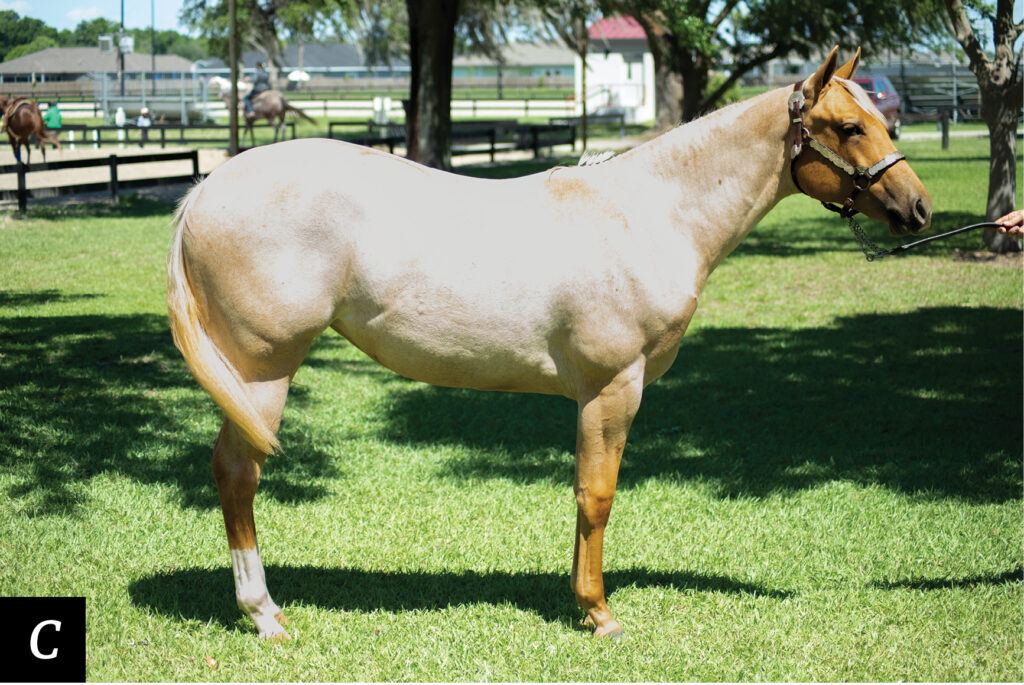
🥉 Filly C
This filly is the least balanced of this class, with a shorter neck and her hips much higher than her withers. Her back appears short, but she’s quite long through the loins. She has some good individual components, but her uneven topline related to long hind cannon bones, and her shorter, thicker neck are deficits.
Her head is attractive but connects to her neck through a thick throatlatch. Her neck is shorter than the other two fillies’ and ties into her chest deep. Her shoulder is upright, but she has good depth to her heartgirth and shows adequate muscling throughout, with bulkier musculature than the other two fillies.
Her front legs are flat through the knees and have decent slope to the pasterns compared to her more upright shoulder. Her hind legs have much longer cannon bones than her front cannon bones with hocks that sit quite high and contribute to her lack of balance. In addition, she is sickle-hocked, with her hind cannon bones angled forward when her hocks are underneath her.
Rick Baker operates Rick Baker Show Horses in Bluff City, Tennessee, and specializes in developing AQHA and APHA horses for the halter division. He showed the 2020 AQHA world champion performance halter horse in addition to numerous other champions at the AQHA World Show and All American Quarter Horse Congress. A judge since 1993, Baker currently holds AQHA, NSBA, and WCHA cards, and has judged at the Congress, NSBA World Show, WCHA Futurity, and other top events.
To submit a photo of your horse to be evaluated in Conformation Clinic, send us a left-side profile photo of your horse (high-resolution, 300 dpi, in at least 3″ x 5″) to [email protected] with your contact info and your horse’s breed, age, gender, and height. We welcome all breeds!