



These mares would be typical of what I see in ranch conformation classes, with more casual presentation than a regular halter class. I always begin by assessing overall balance, then structural correctness to back up that balance. I’m looking for the horse that will provide the smoothest ride and stay sound through a working career the longest. In ranch conformation, mares, geldings, and stallions show together, and do take into consideration a mare’s feminine traits.
To stay organized and find the best horses, I put my classes in groupings, with the horses that are free of major faults in my top group, and any horses with major faults in my second group. I find the best in each group, and that helps me place them in an orderly manner. Presentation, even without the gloss of a regular halter class, matters very much, and with these three mares, I will place them based on what I can see in these photos and some guesswork based on uneven ground or without proper stances in some cases.
How to Take a Good Conformation Clinic Photo
The Placings
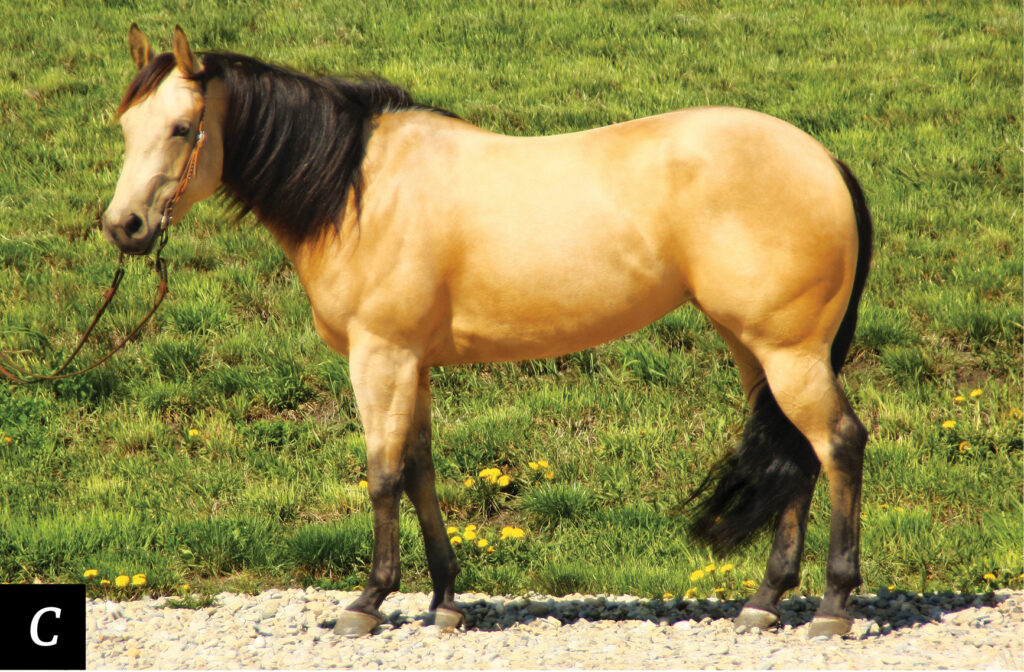
🥇 Mare C
This 17-year-old buckskin mare has the best balance in this class. Even though her head is turned toward the camera, I can see many positive traits. Though she is slightly long in her middle section and back, she has a level topline, nicely prominent withers, an appropriate slope to her croup, and a nice set to her tail.
Her turned head enables me to see her attractive face and nice, wideset eyes, but doesn’t allow me to see her neck well. Compounding that, her mane completely obscures her throatlatch. From what I can see, her neck is a bit short, especially in relation to her length of back. Her shoulder shows good slope and her depth of body is good. Her muscling is adequate and evenly distributed.
She’s generally correct in her legs, with good pastern length and slope. Her left front hints at a broken-forward pastern-hoof axis, but because she is standing in rocks, I’ll give her the benefit of the doubt. Her hocks may be slightly over-angulated, but her hind cannon forms a nice plumb line to the ground.
Put your Conformation Clinic skills to the test!
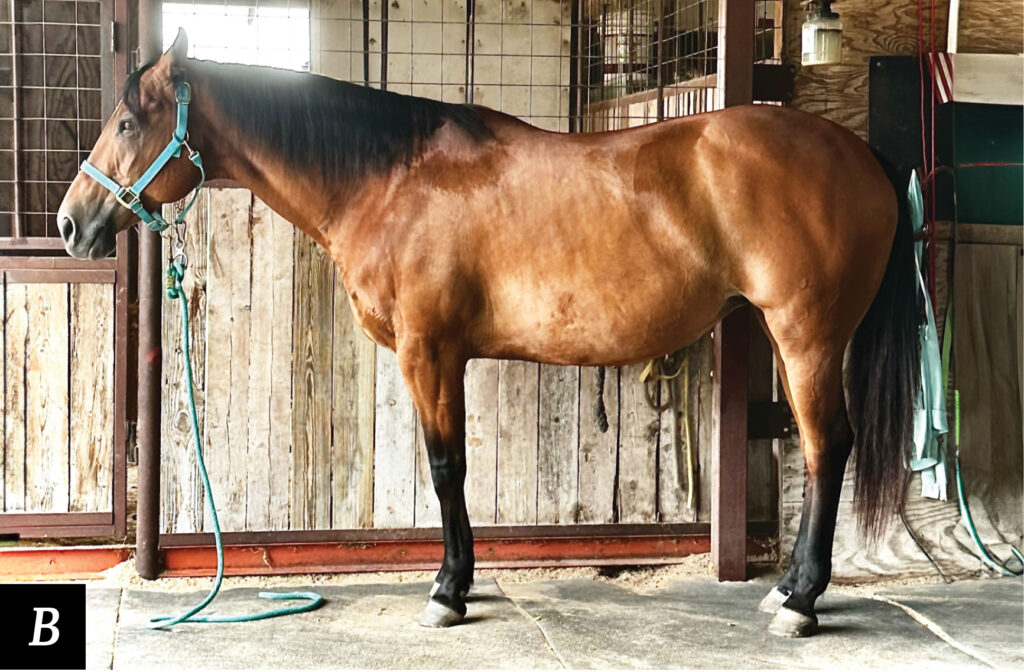
🥈 Mare B
This 15-year-old bay mare has a level topline, adequately prominent withers, and her back doesn’t appear to have dropped. However, she lacks Mare C’s overall balance, as she’s long in her middle section and shorter and steeper in both her shoulder and hip.
Though she has a kind eye, her head is long from eye to muzzle and not as feminine as Mare C’s. Her neck is of good length, but could be trimmer through the throatlatch and could tie in a bit higher to her chest. She lacks overall conditioning, and notably lacks muscling in her forearm and gaskin.
Her legs present some structural issues. She appears slightly back at the knee, and ties in tightly behind the knee with very light bone in her cannon bones. The right front leg showing behind the left front gives the appearance of a bowed tendon, but it may be an illusion of the photo. Her front hooves appear to have different angles from each other. Her hocks are very straight, yet her hind legs are well in front of the ideal plumb line.
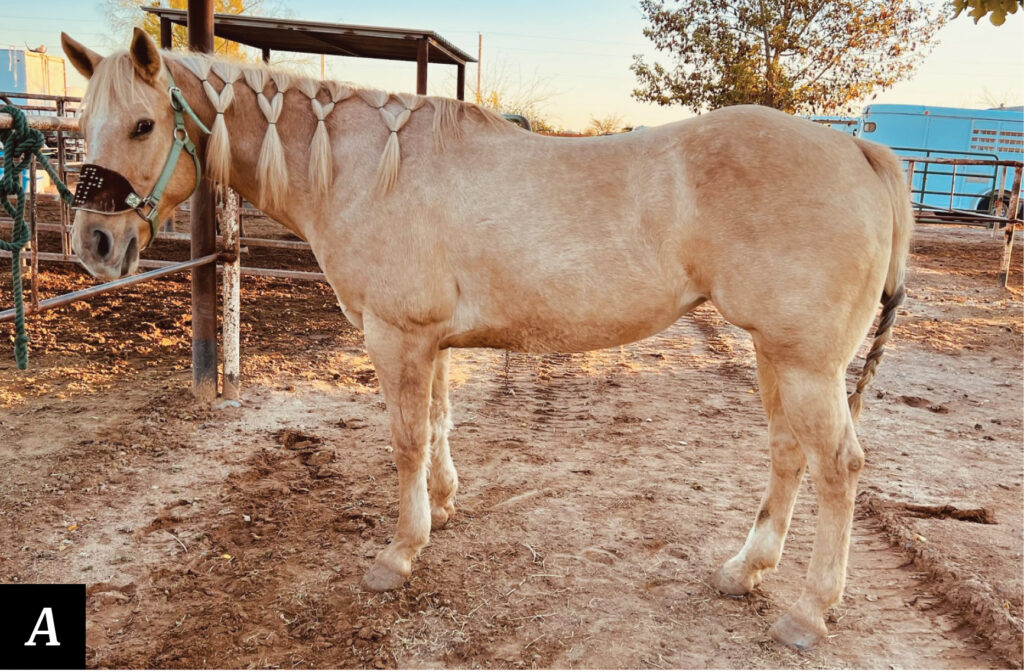
🥉 Mare A
This 15-year-old mare’s stance makes her difficult to evaluate, but I can see that her overall balance places her behind the other two mares. As with the other two mares, her back is long, but it also looks dropped, perhaps showing her age more, and her croup is very short with a high-set tail.
She has a kind eye and a good shallow mouth, but her head lacks the refinement of Mare C’s. Even with her head turned, her neck appears adequately long, though it ties in low to her chest. Her shoulder shows adequate slope, but I’d like to see more depth to her heartgirth. She would benefit from better overall conditioning and muscling.
Her left front leg forms a good straight column through the knee and her pastern has good length and slope. However, her right front leg appears to toe out. Her hind legs show a similar relationship, with a good hock angle and a plumb line to the ground through the cannon bone in the left hind, but toeing out more dramatically on the right. I believe we’d see that she’s cow-hocked if seen from behind.
Sandy Jirkovsky and her husband, Jim, own and operate J Bar S Training in Whitesboro, Texas, and specialize in ranch horses. A judge for nearly four decades, Sandy is carded with the AQHA, APHA, ApHC, NRHA, NRCHA, and NSBA, and has judged major shows throughout the U.S. and Europe. She’s a member of the Professional Horsemen for AQHA and APHA, and serves on the APHA Judges Committee and Youth and as an Amateur Director for the APHA.
To submit a photo of your horse to be evaluated in Conformation Clinic, send us a left-side profile photo of your horse (high-resolution, 300 dpi, in at least 3″ x 5″) to HorseandRider@equinenetwork.com with your contact info and your horse’s breed, age, gender, and height. We welcome all breeds!