



A properly fitted show halter ups the ante in your horse’s appearance and your control in both halter and showmanship classes. The horse shown here is a plain-headed cutting horse, but his halter fits perfectly, which enhances his features. The halter’s adjustment also allows a handler to effectively perform a judge’s requests.
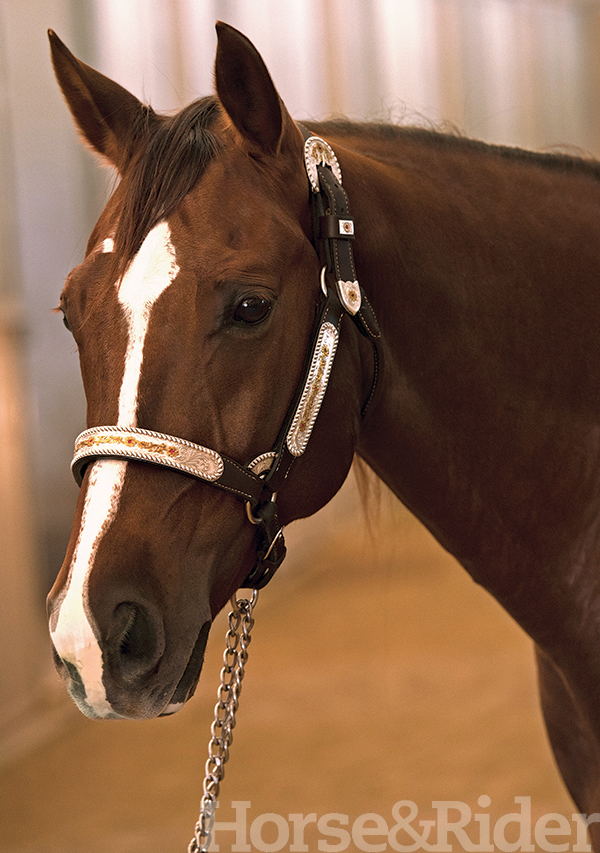
Every horse has a different size and shape to his head, so start with a halter in the correct size. Most show halters come in sizes for weanlings, 2-year-olds, mares, and full-size. Multiple adjustment points, including a buckle on each side and one under the jaw, help achieve a customized fit.
Here are four key fit points to check when adjusting your horse’s show halter for the most professional presentation when you compete.
Cheek length. The cheek pieces influence the fit of every other aspect of the halter, so proper adjustment is critical. When I actively showed halter horses, I had multiple halters with different lengths through the cheeks to accommodate different head sizes.
The correct length through the cheeks allows the halter’s nosepiece to sit right above the bridge of the horse’s nose. A too-long halter looks sloppy, and a too-high fit makes the horse’s muzzle look long.
Crown piece. The piece of leather that goes over the horse’s poll and connects the two cheek pieces at the buckles should sit right behind his ears. Most show halters have adjustment buckles on each cheek piece, which can help with this placement. A too-long crown will hang too far behind the horse’s ears; a too-short one will pull the entire halter up too high on the horse’s face.
Throatlatch. Look for a close fit here for a tidy appearance. This enhances a horse’s naturally clean throatlatch or helps disguise a thicker one. A loose fit in the throatlatch hangs and looks sloppy, and a tight fit climbs up into the middle of the horse’s jowl, indicating a too-small halter.
Nosepiece. Many show halters have a separate adjustment around the horse’s nose. This allows a horse with a refined head to achieve a good fit without the halter looking too big around the nose. Be sure to adjust the nosepiece comfortably—well-fitted for the horse’s nose, but not irritatingly tight.
Shank. Most show halters have a leather shank with a chain on the end that attaches to the halter. Some breed associations have instituted rules forbidding lip chains and instead allow lip cords.
As shown in the photo above, my chain is in a legal position, looped through the bottom ring of the halter and back to the shank. In this position, be sure that your chain isn’t too long, even when it’s doubled-back to your shank. You can’t hold onto the chain, so a too-long chain affords less control than a shorter one.
Alternatively, the chain can run through the halter’s near-side lower ring, under the horse’s chin, through the off side’s lower ring, and then connect to the halter’s top ring on the off side. (Shown above.) If the chain is too long in this position, loop it back to the off-side bottom ring to take up the extra slack.
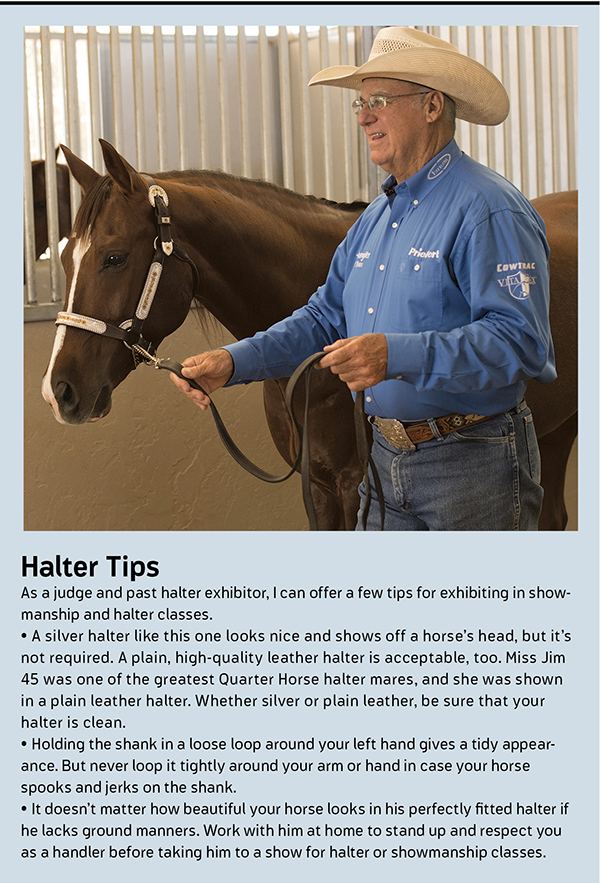
You may also choose a leather lead shank without a chain that snaps directly to the ring at the bottom of the noseband.
Al Dunning, Scottsdale, Arizona, has produced world champion horses and riders in multiple disciplines. He’s been a professional trainer for more than 40 years, and his expertise has led him to produce books, DVDs, and his own online mentoring program, Team AD International (teamadinternational.com).