



Evaluate and place these 3-year-old Quarter Horse geldings. Then see how your choices compare to our expert judge’s.
I judge halter classes on the four categories required by the stock breed rule books: balance, structural correctness, breed and sex characteristics, and degree of muscling. Within each of those categories, I identify major and minor faults for each individual horse, then go through a sorting process to find my top horses.
When judging geldings, as with the three in this class, I look for the horse that will make the best riding and performing horse, since he can’t be bred and that will be his vocation. I’m looking for conformation that should provide athletic performance and have the best chance of staying sound. Three-year-olds already show all the positive and negative traits they’ll have throughout their lives, so I judge what I see in front of me now, rather than assuming any changes as they grow.
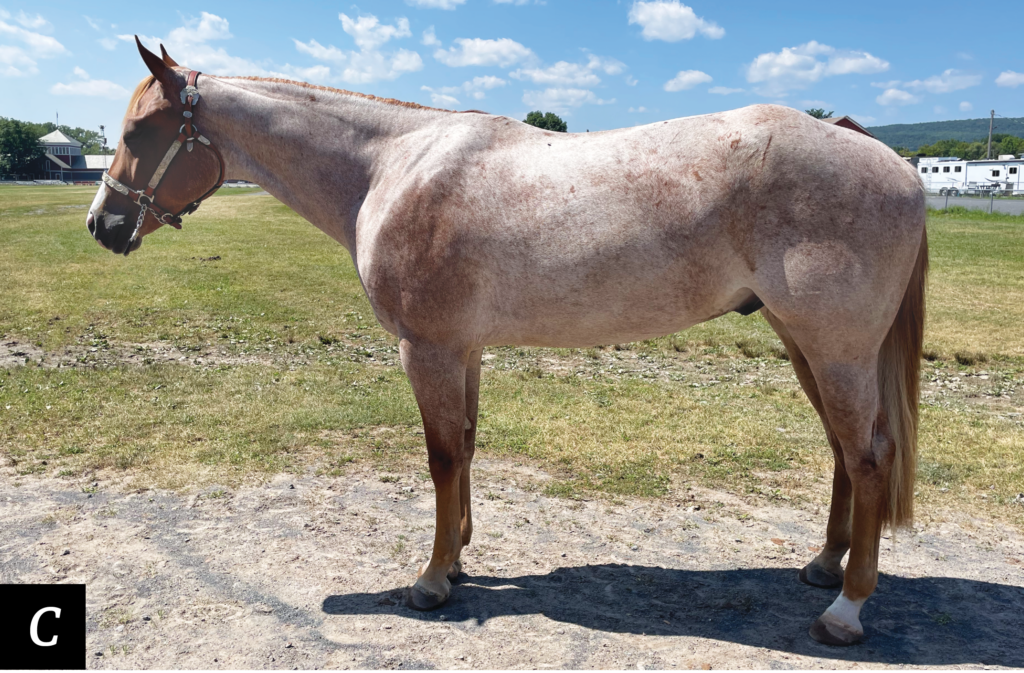
Gelding C
This roan gelding is the best balanced in this group, though his most notable fault is his long middle section. Despite the length of his back, he’s fairly level over his topline and strong across the loin. He could be smoother through the turnover to his croup, but his croup is adequately long and well enough sloped.
Short from eye to muzzle, he has the prettiest head of this group. His neck is suitable in length and ties cleanly into his chest, shoulder, and withers, though his throatlatch could be trimmer. His shoulder has enough angle to provide some scope to his stride, and his hip shows a matching good angle. His heartgirth could be deeper, and his smooth muscling could show a bit more volume and definition.
His legs appear clean and functional. He’s straight through his knees from the side and adequately angled through his pasterns, a good match to his shoulder angle. His hocks are nicely set to drive from the hind end and are fairly level with his knees. I’d choose him as my riding horse of these three.
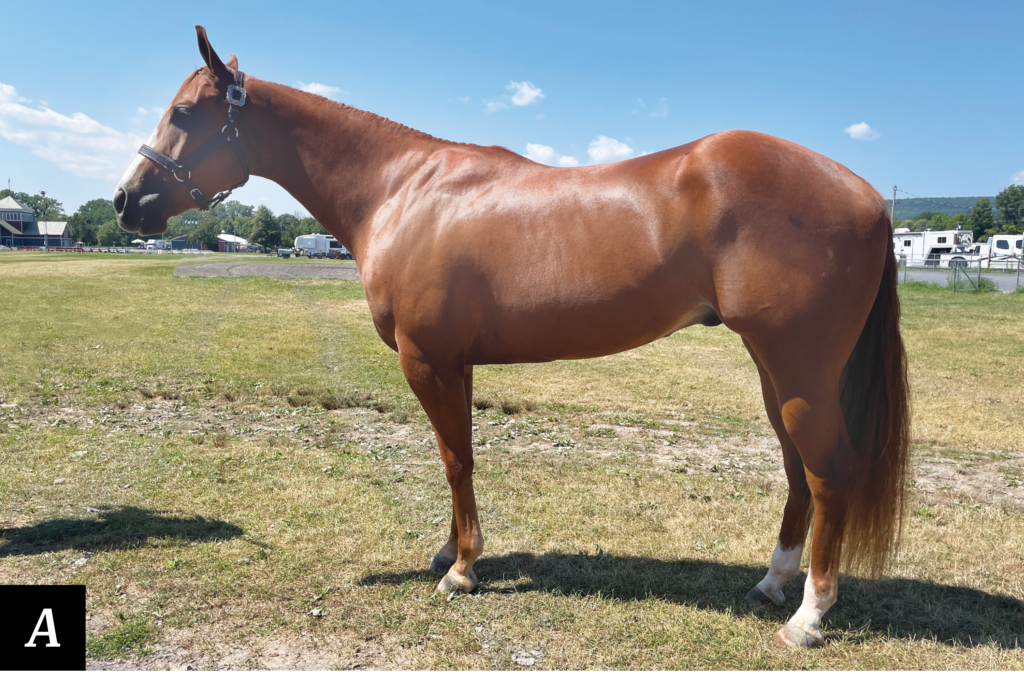
Gelding A
This gelding is also long in his middle section but lacks Gelding C’s levelness and strength across his topline. His long back rises to the turnover of his croup, which sits much higher than his withers. His croup is of adequate length and smoother than Gelding C’s, but overall, he has the weakest topline in the group.
His head is a bit long from eye to muzzle with longer ears, but he has the best neck of these three geldings. It’s of suitable length, tidy through the throatlatch, nicely shaped, and ties in cleanly at top and bottom. His shoulder is adequately sloped for a reaching stride, but he’s shallow through his heartgirth and could show more muscle definition.
Assessing his legs takes some figuring, as his hind end seems to be closer to the camera than his front end. Accounting for that, his hocks may be more level with his knees than they appear here. His pasterns match his good shoulder angle for a cushioned stride, and his hocks appear nicely angled for the ability to drive from his hind end.
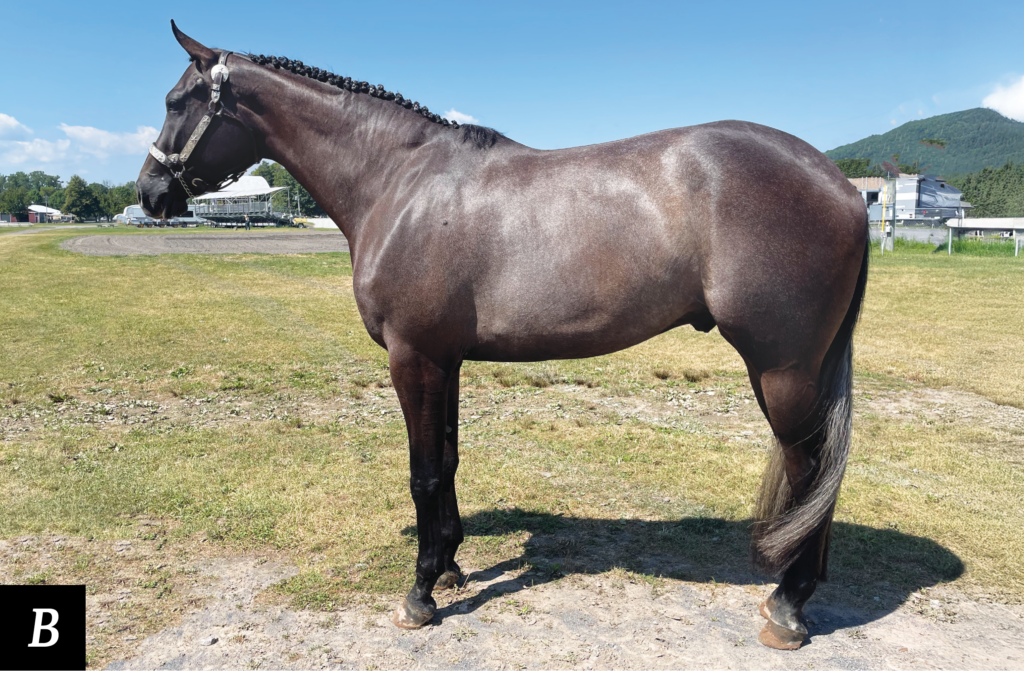
Gelding B
At first glance, this horse seemed to have an advantage with his short, strong back. However, some of his angles place him third. His topline shows strength, but the turnover to his croup is slightly higher than his withers, and his croup falls off a bit behind.
His head is average and connects to a slightly thick throatlatch. His neck is shorter than ideal, matching his shorter croup on the hind end. His biggest fault, though, is his extremely steep shoulder, which will limit his reach and make for a stiffer stride. His heartgirth has adequate depth, but his muscling could show more definition.
He appears to have some lumpiness through the front of his knees, and he ties in tight behind his knees. His front pasterns match his very upright shoulder, again limiting his stride. His hind pasterns are upright, as well. His tail obscures full view of his hocks, but with benefit of the doubt, they appear adequately angled. His hocks sit higher than his knees, though, which goes along with his slightly downhill topline.
Louis A. Hufnagel, based in Tulsa, Oklahoma, has owned, bred, trained, and shown multiple world champions in multiple breeds and disciplines. First carded as a judge in 1971, he currently holds AQHA, APHA, PHBA, ABRA, and NSBA cards. He has judged almost every significant stock breed show and has also judged in countries around the world.
Enter Your Horse in Conformation Clinic!
To submit a photo of your horse to be evaluated in Conformation Clinic, send us a left-side profile photo of your horse (for digital photos: high-resolution, 300 dpi, in at least 3″ x 5″) to HorseandRider@equinenetwork.com with your contact info and your horse’s breed, age, gender, and height. (We welcome all breeds!)