



Evaluate and place these stock breed ranch geldings. Then see how your choices compare to our expert judge’s.
Judging conformation includes the usual evaluation of balance, structural correctness, attractiveness, quality, and muscling, but can also include individual experiences and opinions. In this class, I’m looking for the horse that I think would make the best ranch working prospect.
I evaluate first and foremost on balance. I’m also looking for a functional neck, trim throatlatch, deep heartgirth, short back, and a long hip for power. Balance and eye appeal are usually the signs of an athletic horse that not only looks good but also performs well.
Next, I evaluate structural correctness. Does the horse have a long sloping shoulder, deep heartgirth, short strong back, and legs and feet free of major deviations? Horses with leg and feet problems will be placed lower as soundness means everything to any performance or working horse.
How to Take a Good Conformation Clinic Photo
The Placings
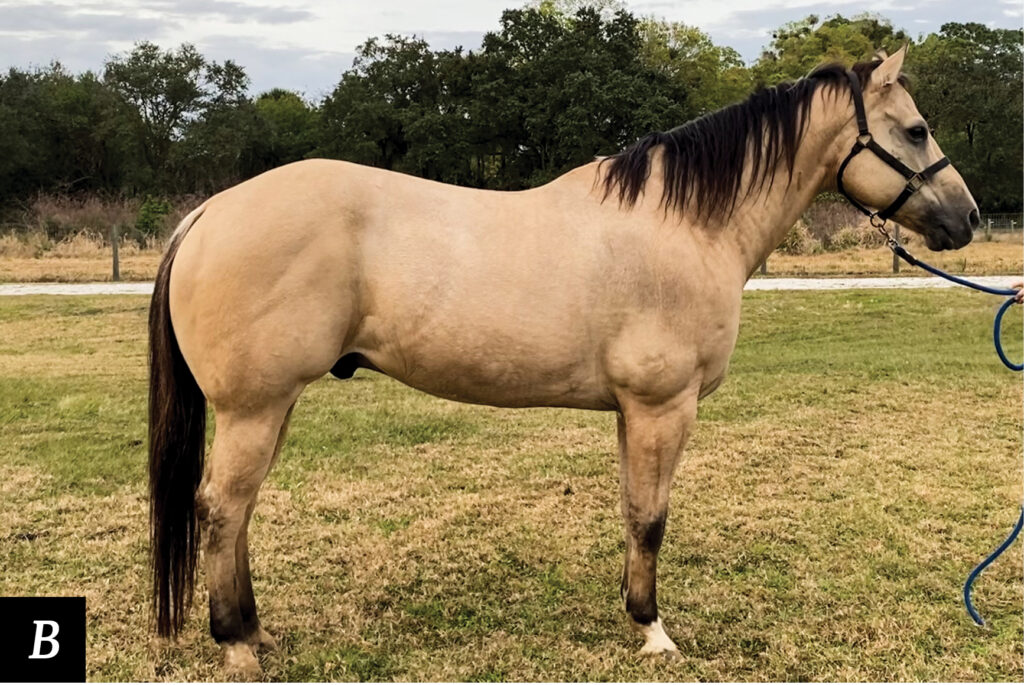
🥇 Gelding B
This gelding can be divided into three even segments making him the best balanced, and likely the best performing, horse of these three. His strong topline features well-defined withers, a short back, and a smooth turn over his croup.
He has a bright expression and an attractive head that attaches nicely through a clean throatlatch. His shapely neck ties in well to his chest, and though it could be longer, it’s not short enough to compromise his balance. His shoulder and hip show good angles, and he has good depth of heartgirth. His overall muscling is of adequate volume and definition, though he could show more muscling in his forearms and gaskins.
He appears correct in his legs from the side view, with front pasterns that match his good shoulder slope for a smooth ride. His hocks show a good angle, with a plumb line from his hocks through his hind cannon bones to the ground. With balance as the most important thing I look for, this horse should make a nice all-around horse.
Put your Conformation Clinic skills to the test!
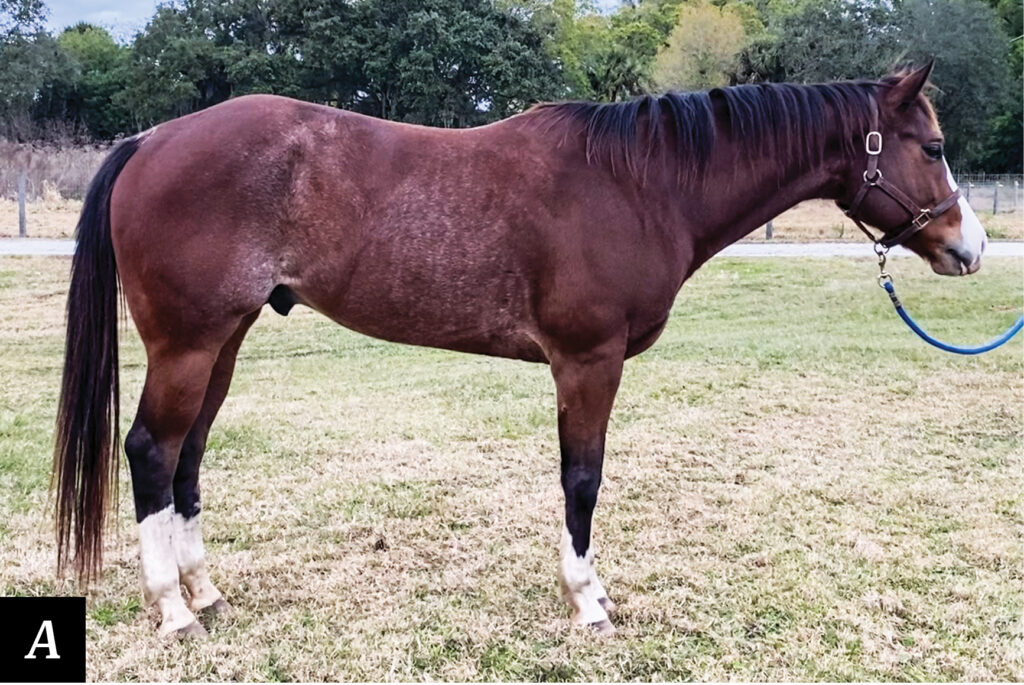
🥈 Gelding A
This gelding lacks the balance and muscling of Gelding B. He is longer than ideal in his middle segment, with less substantial shoulder and hip segments. His withers are well defined, but his topline is long and weak over his loin and croup.
He has an attractive head and trim, clean throatlatch. His neck has plenty of length, but ties in low to his chest, which may make him heavy on his forehand. His shoulder is steeper than Gelding B’s, and he is much lighter-bodied, without the depth of heartgirth. He lacks overall muscling with little volume or definition, and appears to need conditioning.
His front pasterns are long and match his steeper shoulder angle, which may lead to unsoundness. He appears very light-boned through his front fetlocks, but I believe that’s an illusion caused by dirty fetlock hair. He lacks muscling in his forearms, stifles, and gaskins, which will limit his power as a performance or working horse. His hocks have a bit too much set and are higher than
his knees.
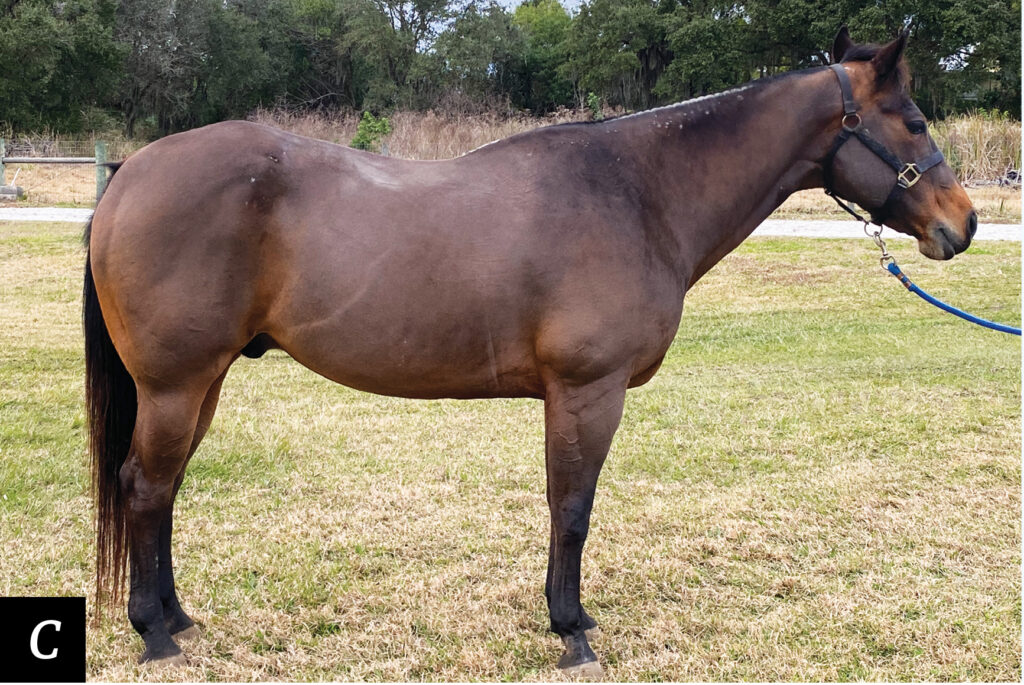
🥉 Gelding C
This gelding also lacks the balance of our class winner, as he’s long in his middle and shorter in his shoulder and hip. His back appears to have dropped, which may indicate age or simply weakness in his topline. His croup is quite short, and his dropped back gives his underline a pot-bellied appearance.
His average head shows a pleasant expression, and his throatlatch is trim. Though his neck is long enough, it appears heavy on its underside and could tie into his chest higher. This is often a trait of horses that are heavy on the forehand. His shoulder angle is adequate and he has good depth of heartgirth. He could use more overall muscling, though he has more than Gelding A.
His front legs are flat through the knees with pasterns that are shorter and sturdier than Gelding A’s, but he appears to toe out noticeably with his right front leg, which could lead to unsoundness. His hock angle is acceptable, and his hocks are fairly level with his knees.
Sandy Jirkovsky and her husband, Jim, operate J Bar S Training in Whitesboro, Texas, and specialize in developing all-around horses and riders. A judge for 30 years, Jirkovsky holds cards with AQHA, APHA, ApHC, NRCHA, NRHA, and NSBA. She has judged multiple world championships, the All American Quarter Horse Congress, NRHA Futurity, NCEA National Championships, and other major shows throughout the world.
To submit a photo of your horse to be evaluated in Conformation Clinic, send us a left-side profile photo of your horse (high-resolution, 300 dpi, in at least 3″ x 5″) to HorseandRider@equinenetwork.com with your contact info and your horse’s breed, age, gender, and height. We welcome all breeds!