



While it’s important to know how to stop in an emergency, such techniques aren’t the best way to stop your horse during everyday rides. Instead, learn to stop your horse with voice and seat cues and without needing to pull on the reins.
[READ: Stopping Exercise for Horse & Rider]
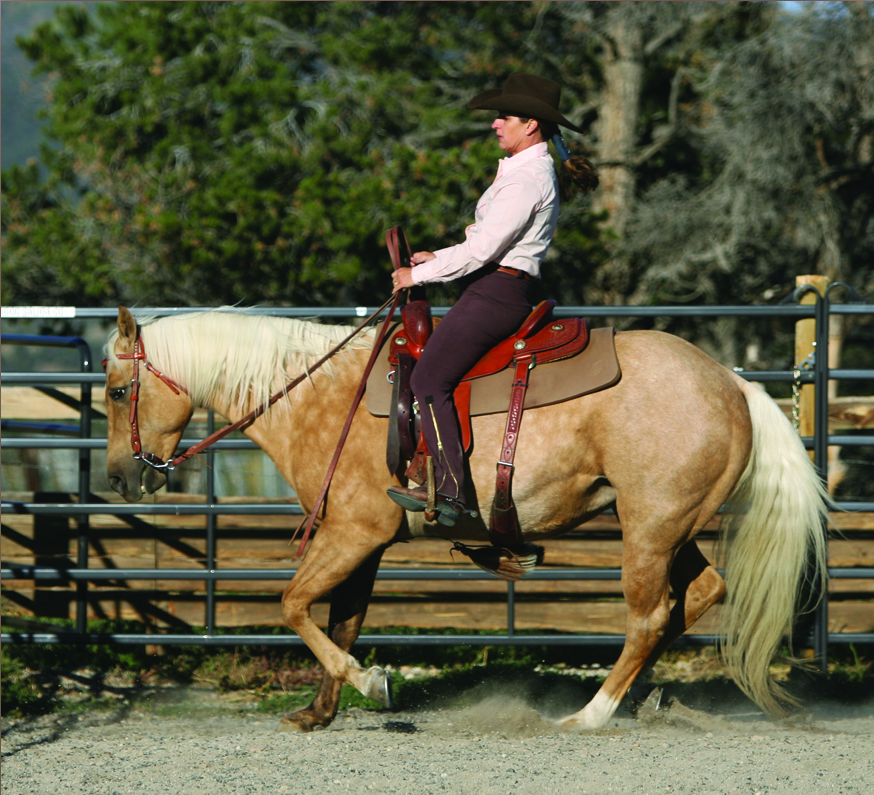
By using your voice and seat as stopping cues, you’ll help your horse understand that you want him to slow down. This will give him the chance to stop willingly, so you won’t have to apply rein pressure to his mouth during everyday riding.
(Note: For Goodnight’s Horse Master video clips on how to teach the stop, visit https://horsemaster.tv, and look for “Out of Hand” and “Whoa Means Whoa.”)
Avoid the Pull
If you pull on two reins to stop your horse, the pressure on his mouth is so great that he’ll lean into and brace against it. If he is constantly leaning into the pressure, he’ll develop a stiff brace in each side of his neck.
When this happens, you’re in a tug-o-war with the horse—a game that’s impossible to win, because of the weight difference between you and him.
It’s imperative that you use your seat/weight aid when asking your horse to stop, Goodnight teaches. If you pull on the reins first, without using your seat, you are sending him conflicting signals. Your seat says go and your reins say whoa.
3 Steps to the Stop
When teaching any new cue to your horse, sequence the cue into three parts. In this case, the three steps consist of the following:
- Step 1.Exhale, and say “whoa.”
- Step 2: Shift your seat/weight back.
- Step 3: Pick up the reins, but only if necessary.
If your horse ignores the pre-signals and needs a bit of rein pressure as a teaching tool, pull back gently with a right-left motion, instead of pulling on both reins at the same time.
If you use this sequence consistently, your horse will learn to stop before you ever touch his mouth.
(Note: For details and a visual aid, go to www.juliegoodnight.com, and look for Goodnight’s Principles of Riding DVD, “Communication and Control.” You’ll learn to break down the whoa cue into distinct parts, so that your horse gets a pre-signal with your voice and seat before feeling pressure on his mouth.)
[READ: Invisible Riding Cues]
Enlist a Friend
Although this pattern seems simple, it’s not always easy to distinguish your cues into three parts. Have a knowledgeable riding buddy watch you to make sure that you’re making this distinction. Ask her to make sure you’re first saying “whoa,” then shifting your seat, then picking up the reins.
Your friend just might catch you saying whoa and using your seat at the same time—even if you feel like you’re executing these steps in order.
Keep practicing! Your horse will love you for it! All horses are happy to do that if they know it to be an option. No horse in the world wants you to pull on his mouth.
Julie Goodnight (www.juliegoodnight.com) lives in central Colorado, home to miles of scenic trails. She trains horses and coaches horse owners to be ready for any event, on the trail or in the performance arena. She shares her easy-to-understand lessons on her weekly RFD-TV show, Horse Master, and through appearances at clinics and horse expos held throughout the United States. She’s also the international spokesperson for the Certified Horsemanship Association (www.cha-ahse.org).