



A subtle, but effective, stop can build into more confident cues and responses for riders of all levels.
If you want to take your horsemanship to the next level and communicate with more subtle cues, it starts with one fundamental skill: a correct, consistent stop. Before you worry about speed, patterns, or advanced maneuvers, you need to know that your horse understands how to stop willingly and softly every time you ask.
Whether you come from a general riding background and have heard people talk about the one-rein stop made popular by clinicians, or you ride with a more traditional, show-style two-rein stop, the goal is the same: clear communication and consistency.
I tell my clients to start at a walk or a slow jog and make sure you can consistently get a correct stop using all of your cues—your voice, your hands, and your feet. Saying “whoa” should create an immediate response from your horse regardless of the discipline.
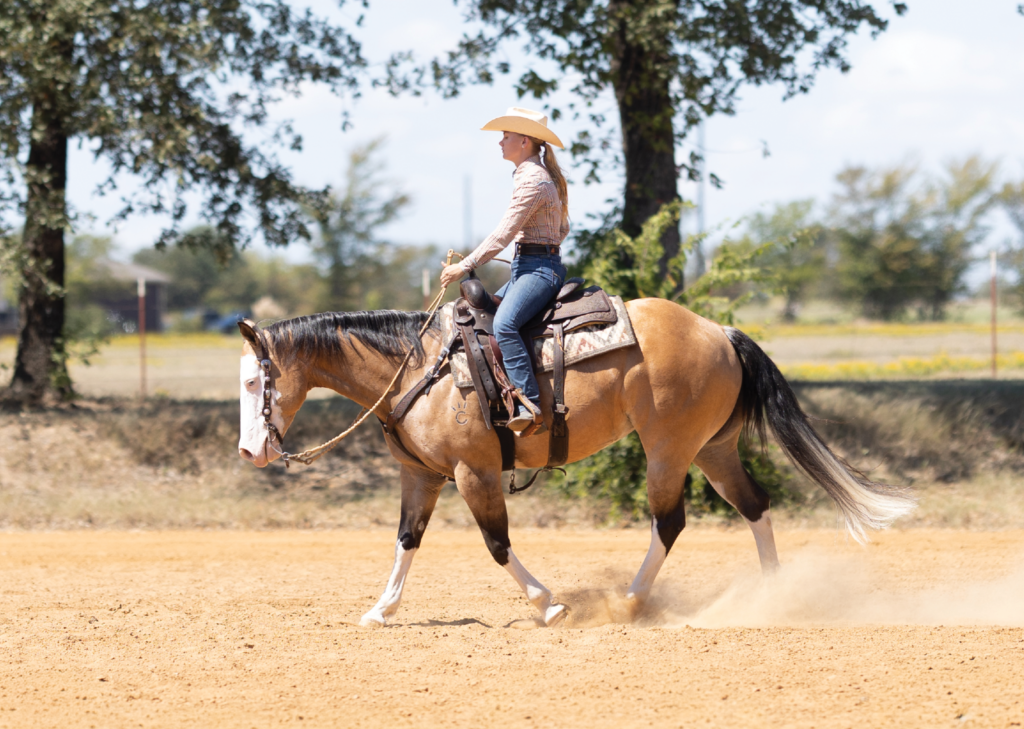
Understanding Your Cues
How you use your hands and feet may vary depending on your background. If you come from an all-around horse show background, you’re probably familiar with the spur stop, where your feet stay on the horse rather than releasing. If you come from a more working or general horsemanship background, you may be used to releasing pressure with your feet and using your reins to ask for the stop.
Neither approach is inherently right or wrong. What matters most is that your cues are clear, fair, and consistent so your horse can understand exactly what you’re asking.
Use Your Body to Support the Stop
In addition to using your voice and hands, and releasing your feet, I want you to pay close attention to your body position. Most riders naturally sit deeper in the saddle or tip their upper body slightly back when they ask for a stop, and that change alone helps signal the horse that a transition is coming.
Leaning forward in the saddle is an inherent cue to go forward. Squeezing with your legs is also an inherent cue to go forward. That’s why body awareness is such a critical piece of perfecting your stop.
When you say “whoa”, release your feet, and softly pick up on the reins. Make sure you’re staying upright, or even slightly back, in the saddle. At the same time, open your thigh and soften through your knee so you’re not accidentally telling your horse to go while you’re asking him to stop.
Many riders think they’ve taken their legs off when they ask for a stop—and maybe they have from the knee down—but they’re still squeezing with their knee and thigh without realizing it.
I think a lot of that comes from what many of us learned in English disciplines, where you’re taught to keep your knees on the horse and maintain constant contact. But in a Western saddle, your primary leg contact comes more from the knee down. From the knee up, I want you to stay much more relaxed. That softness is what allows you to truly communicate with your horse.
When you squeeze through your knee and thigh, it actually pops you up out of the saddle. That makes it harder to stay connected to your horse, and it can give him a false sense of urgency—almost like you’re telling him to go when you’re trying to stop.
Being aware of what’s happening between your knee and your seat is extremely important, especially if you want to progress to higher-level maneuvers and more advanced riding.
Learn From High-Level Riders
To put this into perspective, think about watching a high-level reining horse stop. If you really study a top trainer during a sliding stop, you’ll notice that their main point of contact is through their lower leg and their foot in the stirrup.
From what I’ve observed and experienced myself, your foot in the stirrup becomes your primary anchor point, while the rest of your body stays soft and balanced over the horse, absorbing the motion of the stop. When your knee and thigh are tight, you lose that ability to absorb movement. Instead, that tension transfers into your horse’s body and interferes with his ability to use himself correctly.
As a rider, your goal is to stay soft on top and let your body follow the motion, rather than fighting it. That’s what allows your horse to stay balanced and confident through the maneuver.
Executing a Balanced Stop
If you’re riding a greener horse, start slow. Begin at the walk or trot and focus on being consistent with your cueing every single time. Apply your cues in a clear, repeatable way so your horse can understand what you’re asking. Horses learn through repetition and consistency. Once you’ve mastered the stop at the walk and trot, then you can move up to the lope.
I also strongly recommend starting these exercises in a controlled environment, like an arena. That way, if something doesn’t go quite right, you’re in a contained, safe space. From a safety standpoint, working on your stop in a controlled setting is always the smartest approach.
When you start progressing into higher-level maneuvers—like working down the fence on a cow—you need to be able to use your hands, legs, and voice together. In an ideal situation, your leg and your voice become your primary cues for the stop, and your hands move into more of a supporting role.
You don’t see top reiners pulling on their horses—you see them balancing their horses. That’s an important distinction. The hand and foot cues become support tools, not the main message.
When your horse is truly trained through consistent, correct repetition, your cues become more subtle. They start relying on your hands as guidance rather than direction—and that’s the result of doing the basics right, over and over again.