



I’ve spent my entire riding career in judged events.
Events where you spend months chasing perfection, trying to make every maneuver cleaner, smoother, and more correct than the ride before. Even in the cow horse, where there’s speed and a cow involved, you still have a scorecard at the end of the run. You’re judged on quality, style, and execution.
I’d worked cattle before. I’d competed in the boxing events and even learned to go down the fence under the guidance of Ride TV coach Brad Barkemeyer. (If you want to see me in all my glory, check it out here.) I understood rate and reading a cow to know what its “bubble” is. But nothing quite prepares you for the feeling of looking up at a timer and realizing you have less than 60 seconds to sort 10 cattle in a specific order.
For the first time in a really long time, I felt genuinely new at something again.
A Different Kind of Pressure
The clock changed everything. Suddenly, it wasn’t just riding into a herd to cut one cow away from the rest. It was going into a herd quickly, but not so fast that the cattle scattered in every direction. It was keeping the cattle moving throughout the round pen so they don’t think about going toward the gate. It was making sure I remembered what number cow needed to be sorted. I had to react quickly, trusting my instincts and staying mentally calm while things sped up around me.
Learning to Trust the Process
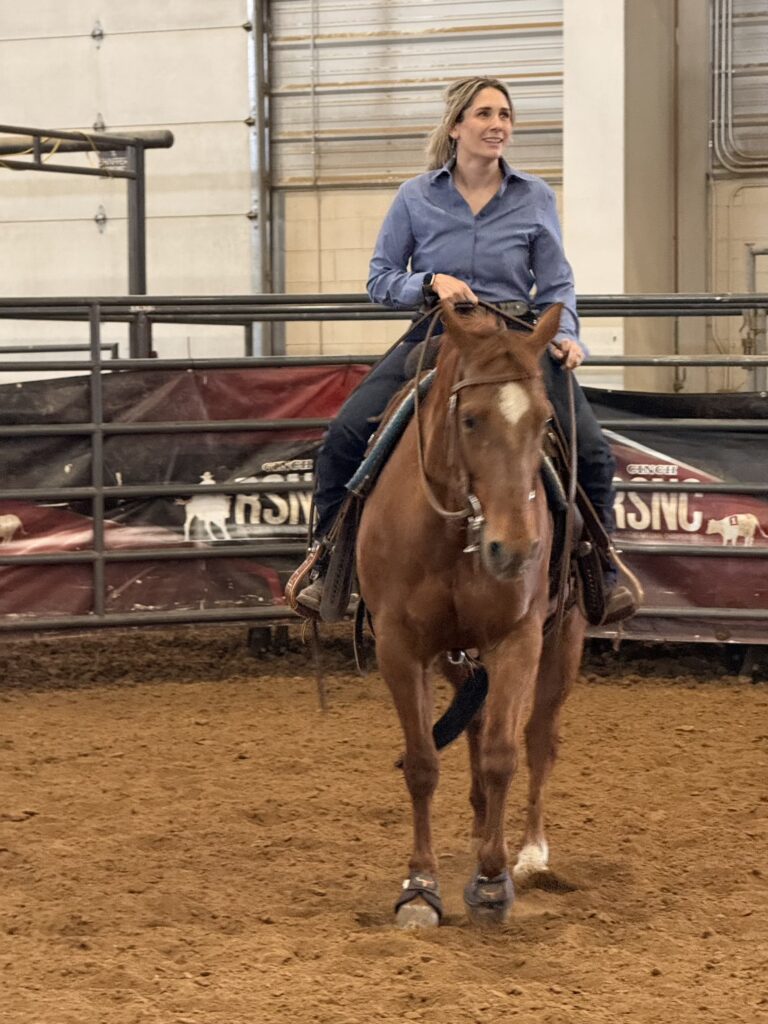
On day one, I competed in the rookie class. I sorted all of the cattle while my partner, who had more experience in the sorting pen, manned the gate. Knowing he had the gate under control while I got comfortable going into the herd helped me relax and focus on the task at hand.
One of the biggest adjustments for me was learning how much ranch sorting depends on teamwork. I rode on an NCEA equestrian team in college, which technically made it a team sport, but it wasn’t the same thing. When you entered the arena, it was still your ride, your score and your point on the line. What happened in that moment depended entirely on you.
Ranch sorting is different. You can’t be successful without your partner. Every decision affects the other person, and every move they make affects you. You have to pay attention not only to what you’re doing, but also what your partner is doing, what their horse is doing, and what the cattle are trying to do. If you’re not communicating, reading the situation and working together, things can unravel pretty quickly.
As someone who has spent most of her riding career competing individually, I found that to be one of the most interesting parts of the sport. Success wasn’t about being the best rider in the pen. It was about being part of a team for 60 seconds and figuring out how to work together to get the job done.
And somewhere in the middle of all of it, I managed to sort nine cows in order during the first round of the rookie, which left us sitting in sixth out of 73 teams.
In the next round, we let a cow get through the gate that shouldn’t have, so we were a no time. But the idea of successfully sorting nine cattle in my first ranch sorting had me so excited to get in the pen and try again.
The Power of a Good Teammate
The #6/#4 Incentive presented a different challenge. Unlike the rookie class, where I focused on learning the flow of the game and getting comfortable sorting cattle, this class put me in the arena with a partner who had significantly more experience than I did.
In ranch sorting, there are two ways you match up with a partner: you can either randomly draw one or choose one. As a first-time sorter, I assumed I’d draw someone and do my best not to get in their way. Instead, a rider who had won a significant amount of money in the sorting pen watched me ride and asked if I wanted to partner with him.
To be honest, it was intimidating. I was riding a horse I’d only been on for a few minutes and competing in an event I’d never done before. And of course, my first thought was, “What if I let my partner, who asked me to ride with him, down?”
Looking back, though, it was one of the biggest compliments of the weekend. Here’s someone who understands the sport, understands cattle, and understands what it takes to be successful in the sorting pen, and he saw enough in my horsemanship to ask me to ride with him. Throughout the run, he coached me, explained strategy, and helped me understand what I was seeing. Even when things didn’t go perfectly, he took the time afterward to walk me through what happened and what I could do differently next time.
Interested in trying out ranch sorting? Check out our Ranch Sorting Masterclass with Logan Wolfe.
A Community That Wants You to Succeed
That experience reinforced something I learned throughout the weekend: ranch sorting may be a timed event, but it’s also a great community. The willingness of experienced riders to help newcomers improve was unlike anything I’ve experienced in other disciplines. In many horse show environments, advice and coaching are transactional. If you’re not paying someone, they’re usually not spending time helping you.
But ranch sorting didn’t feel like that.
People genuinely wanted to see new riders succeed.
I had what were complete strangers the day before, encouraging me, explaining strategy, answering questions, and helping me learn. Nobody cared that I was new. Nobody acted like I didn’t belong there. If anything, they seemed excited that someone new wanted to try the sport.
The Lesson I’ll Take With Me
I didn’t end up winning any money or even placing, but by that point, it almost didn’t matter. I’d already walked away feeling like I’d gained something bigger than a paycheck or a buckle.
I learned that being a beginner again is good for you.
It reminds you what it feels like to think too hard, make mistakes, and have to slow down enough to learn instead of just perform. It reminds you that horsemanship takes different forms across disciplines, and that being successful in one area doesn’t automatically make you good at another.
Mostly, though, I walked away understanding why people love ranch sorting so much.
Yes, it’s fast. Yes, it’s competitive. Yes, it’ll absolutely spike your adrenaline.
But underneath all of that, it felt fun in a way that competing sometimes forgets to be.
And for my first time stepping into the sorting pen, I don’t think I could’ve asked for a better experience.